The world of micro-brands was a bit “meager” a few years ago – generic movements, standard case designs, homage designs. But by 2026, this field had completely changed. Small teams no longer needed to explain to shareholders why there was no growth this quarter, nor did they have to smooth out the designs to meet the demands of the global dealer network. They could spend two years making just one watch, use a color that no one else dared to use, and incorporate the craftsmanship that should have been in the five-figure price range into an affordable case.
The following are the truly “high value for money” choices among current micro-brands. Here, “high value for money” does not mean cheap, but rather that every dollar you spend goes to something visible or tangible.
Baltic MR Series: Miniature Automatic Caliber, the Elegance of a Formal Wristwatch

The smartest aspect of the French brand Baltic lies in its understanding of the essence of vintage formal watches: proportion. The MR series features a 36-millimeter case size, which is considered a restrained size today, but when combined with the Sector Dial and the slender Breguet numerals, it visually appears more expansive. The edges of the dial and the small seconds hand have been given concentric circular textures. These details, which can only be seen under a magnifying glass, are often overlooked in photos, but when worn on your hand, they make you pause for half a second each time you look at the time.
What truly makes the MR series stand out is its movement. At this price point, it is equipped with a micro automatic rotor movement. Micro rotors are usually found in much more expensive watch models because of their complex structure and high assembly requirements. Baltic has priced it at around NT$19,000 (approximately €545), which is almost an act of questioning the entire industry: Why can’t it be like this? Of course, it doesn’t have a stop second function, and the polishing is not particularly stunning, but when you turn the watch over and see that tiny rotor rotating in a limited space, that mechanical “unconventionalness” itself is a kind of pleasure.
echo/neutra 1956 GMT: The Correct Way to Polish the Fade-Out Dial

The 1956 series from the Italian brand Echo/Neutra is named after a period when watch designs underwent significant changes. The most impressive model in this collection is the GMT version. Many brands achieve a “retro fading” effect through sandblasting or chemical treatment, resulting in uniform and artificial colors. Echo/Neutra’s approach is closer to the real logic of aging: there is a slight blending at the junction of the two colors, and the saturation of the color will vary under different light conditions, like a Pepsi ring that has been worn for twenty years, rather than a new watch that has been aged in a factory.
The starting price for the three-hand automatic model is around $1,025. The GMT and chronograph models go up further, but the top-of-the-line model is still under $2,000. The movement is a regular Japanese or Swiss mass-produced automatic, and there’s not much more to say about it. Its value lies entirely in the visual completeness. If you want a daily watch that looks like it has a story but doesn’t require you to spend time telling it, this series is an unavoidable option.
Ferro & Co. Paramount: Calm Without a Second Hand

The latest model of the Paramount series from the British brand Ferro is called Pistachio. It features a 38mm steel case, a pistachio green face, and a pair of deep pink hands along with a matching leather strap. This color combination sounds like ice cream and the actual product does have a relaxed feel reminiscent of an Italian seaside town.
However, it has a serious design decision: there is no second hand. The dial only has the hour and minute hands, and it runs on a manually wound Sellita SW210 movement. What does removing the second hand mean? It means you can’t judge its accuracy. You can only see if it looks good, if it feels comfortable to wear, and if the few clicks of the damping mechanism when you chain it up every morning are pleasant. In an era where everyone is chasing COSC certification and a few seconds of error, a watch that actively gives up the second hand actually reminds you: the act of looking at time doesn’t necessarily require such precision. The price is 725 pounds. The luminous numbers and the hand-matched leather strap are additional signs of sincerity.
Maen Manhattan 37 Ultra-Thin: Stone Plate, Thin Shell, No More Than One Thing

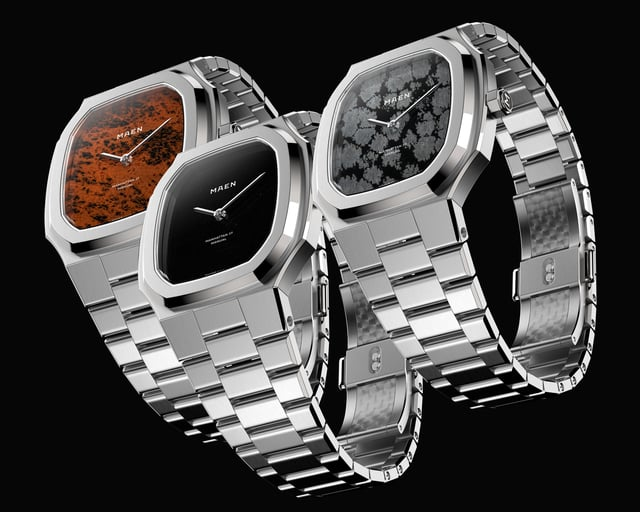
The Manhattan series of the Swedish brand Maen is inspired by the predecessor of Vacheron Constantin 222, Ref. 2215. With a 37mm diameter and a thickness of only 7.1mm, it is equipped with the manual-winding La Joux-Perret D100 movement. This thickness means it can fit into any cuff, including those distorted by modern thick watches.
The latest stone dial version offers three options: onyx, gold swan, and snowflake obsidian. Each is limited to 100 pieces. The dial has been simplified to the extreme: no scales, only hour and minute hands, and the logo. The pure black of the onyx almost absorbs all the light, while the spots of the snowflake obsidian make each one unique. The price is 1,359 euros, which is about 200 euros more than the ordinary dial. But the texture brought by the stones far exceeds this price difference. The price you need to accept is: less convenient for reading, and it is not waterproof – the old rules of formal watches, Maen did not pretend to break them.
The last sentence
The risks of a micro-brand never lie in the movement. The reliability of Japanese Miyota has been proven countless times. The real uncertainty lies in whether the brand can survive until the day you need warranty coverage. But from another perspective, the price you pay doesn’t leave much for “brand premium” and “global warranty network”. What you buy is design, details, and the obsession that a small team has poured into a specific product. These things, big brands sometimes can’t provide, but these few items are generously offered.
