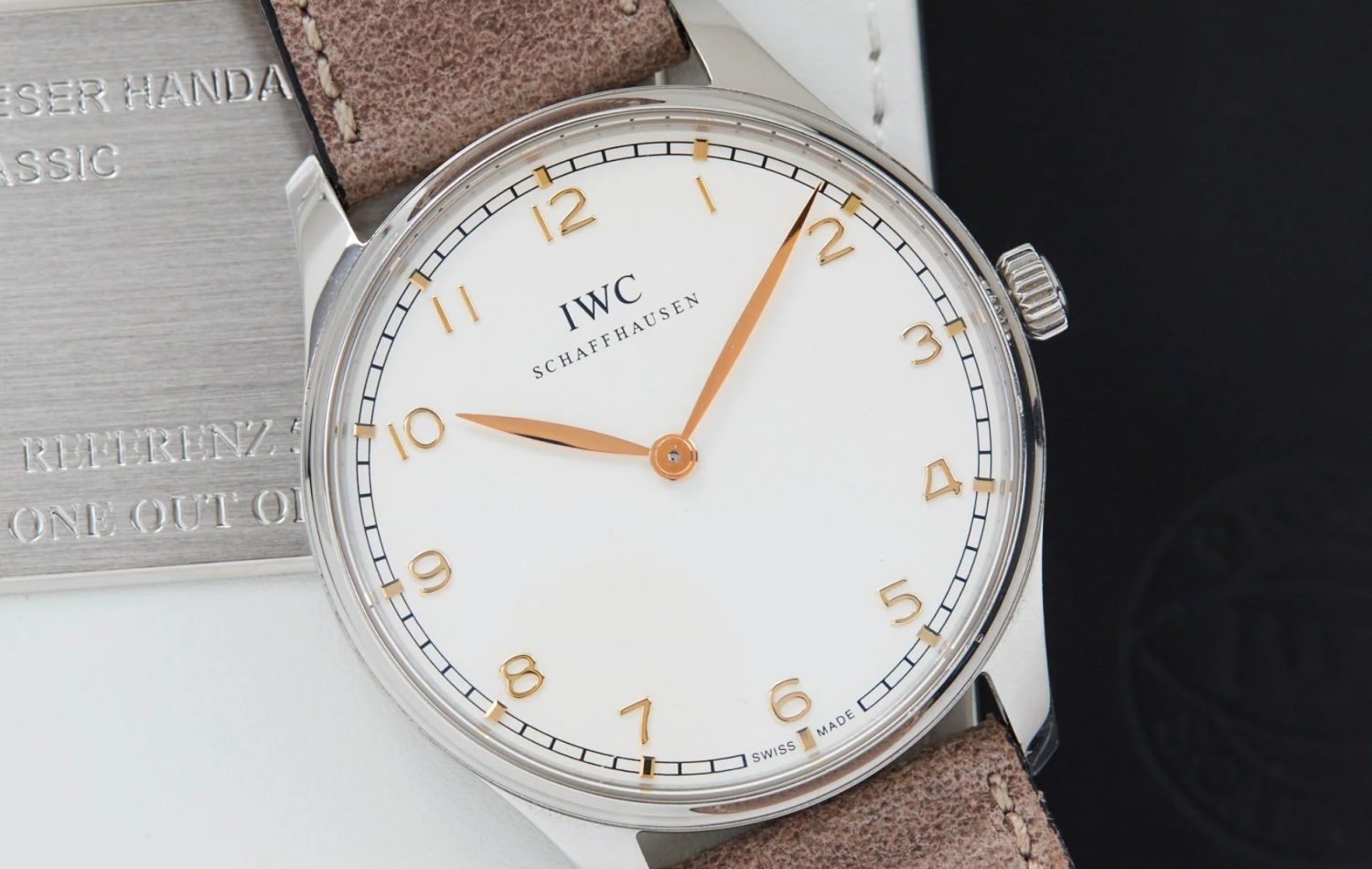
If you are looking for an “appropriate” vintage Union Jack watch, you are likely to get lost on two paths: one leading to the tough engineer-style Ingenieur collection, and the other pointing towards the elegant Portuguese style of navigation. But there is a common pitfall here – the serial number “866” of Union Jack actually belongs to the Ingenieur series rather than Portuguese. However, if you are truly obsessed with the ultra-thin, manual, and purely formal elegance of Portuguese watches, then there is indeed a piece in Union Jack’s history that is more worthy of the title “Vintage Portuguese Ultra-Thin Classic”: Ref. 5703 Pure Classic, and the soul of its anniversary edition Ref. 5441.
This blog post will clear up the confusion caused by the serial numbers and talk about the ultra-thin Portuguese watch that truly stirs the hearts of those who love formal watches.
The confusion regarding the number: 866 actually refers to another “tough guy”

In the world of antique Orient watches, Ref. 866 (commonly known as 866A or 866AD) is a renowned piece, but it belongs to the Ingenieur series. It was born in the late 1960s and is equipped with Orient’s proud Calibre 8541 automatic movement, featuring the iconic Billeton winding system, and is housed in a soft iron anti-magnetic inner case. Its diameter is approximately 37 millimeters, which was considered a “Jumbo” size at that time. Paired with an integrated stainless steel bracelet or Gay Frères grain chain, it is a truly practical luxury sports watch.
So, when you see “866”, please separate it from the slender formal image of the Portugieser. It is classic, but it is the classic of the engineer, not that of the navigator.
The truly ultra-thin Portuguese: Ref. 5703 and its predecessor

The starting point of the Portuguese series is the Ref. 325 from 1939, which features a pocket watch movement, is extremely large in size, but has an extremely narrow bezel, giving an exceptionally spacious visual effect. The true modern revival came with the 125th anniversary commemorative edition of 1993, the Ref. 5441, which was a faithful recreation of the original Portuguese design.
The ultimate expression of the “ultra-thin formal wear” branch emerged around 2010. IWC launched a Portuguese wristwatch named Pure Classic (Ref. 5703). To pursue the ultimate thin and fitting sensation, IWC did not use its own in-house movement but borrowed a super-thin movement from Piaget and modified it into Calibre 62060. The diameter remained at the classic 42 millimeters, but the thickness was compressed to an astonishing degree, fitting on the wrist almost like a coin pressed against the cuff. This watch was limited to 500 pieces and was not even included in IWC’s regular product catalog. It was a code for collectors who truly understand that “formal watches must be thin, light, and unobtrusive”.
Of course, if you are more obsessed with the mechanical beauty of IWC’s in-house manual movements, the regular Portuguese manual-winding models (such as the models with the 98295 movement) are also worth a look. That movement features the famous “Jones’ Arrow” fine-tuning device, and the case thickness is controlled at around 10 millimeters. Against the backdrop of a 44-millimeter large diameter, it still maintains the restraint expected of a formal watch. The white dial, blue steel hands, small seconds hand at 6 o’clock, this is the purest bloodline of Portugal.
Why is “thinness” so important to Portugal?

The Portuguese series is encoded with a paradox: it is large (because it uses a pocket watch movement), but it must also be elegant (because it is the land version of the marine astronomical clock). The thick case would make the large size a burden, while the ultra-thin design resolves this contradiction.
When you slip a Pure Classic or manually wound Portuguese onto the cuff of your shirt, the smooth and unobstructed experience is something that no modern sports watch can offer. It has no heavy automatic rotor, no layers of modules, only the most basic hours, minutes, and seconds, as well as a wide, open dial with Arabic numerals and radial scales. The contrast between the visual grandeur and the tactile thinness creates the most fascinating aspect of antique dress watches.
Suggested Collection Strategy: Identify the Right Target and Avoid Traps
If you came here because of the keyword “Wanguo 866”, please remember:
Don’t mistake Ingenieur for Portuguese Buy: The watches with the “866” serial number on the market are almost all stainless steel sports models. If you want a dress watch, simply search for “IWC Pure Classic 5703” or “Portugieser Hand-Wound”.
Pay attention to manual models: The essence of the Portuguese is manual winding. Whether it’s the replica 5441 or the later 5454 series, the thinness and purity of the manual movement cannot be replaced by the automatic models. The ornamental value of the 98295 movement (especially the Jones’ Arrow) is also a great pleasure to play with.
Accept its “imperfections”: Antique Portuguese watches usually are not waterproof, have a larger size, and manual winding requires you to interact with it for a few seconds every day. But it is precisely this sense of ceremony that makes it stand out even more in the era of flooded smartwatches, as it seems like a quiet mechanical toy belonging to adults.
Final Thoughts
The “WanGuo 866” is a fine watch, but it belongs to the tough era of engineers. The true antique Portuguese ultra-thin dress watch is hidden within the slimness of the Piaget movement in Ref. 5703, within the Jones Arrow of the 98295 movement, and between the clean white dial and the blue hands. If you are looking for the latter, please shift your gaze away from “866” and turn your attention to those more understated, rarer, and truly “Portuguese” names.
