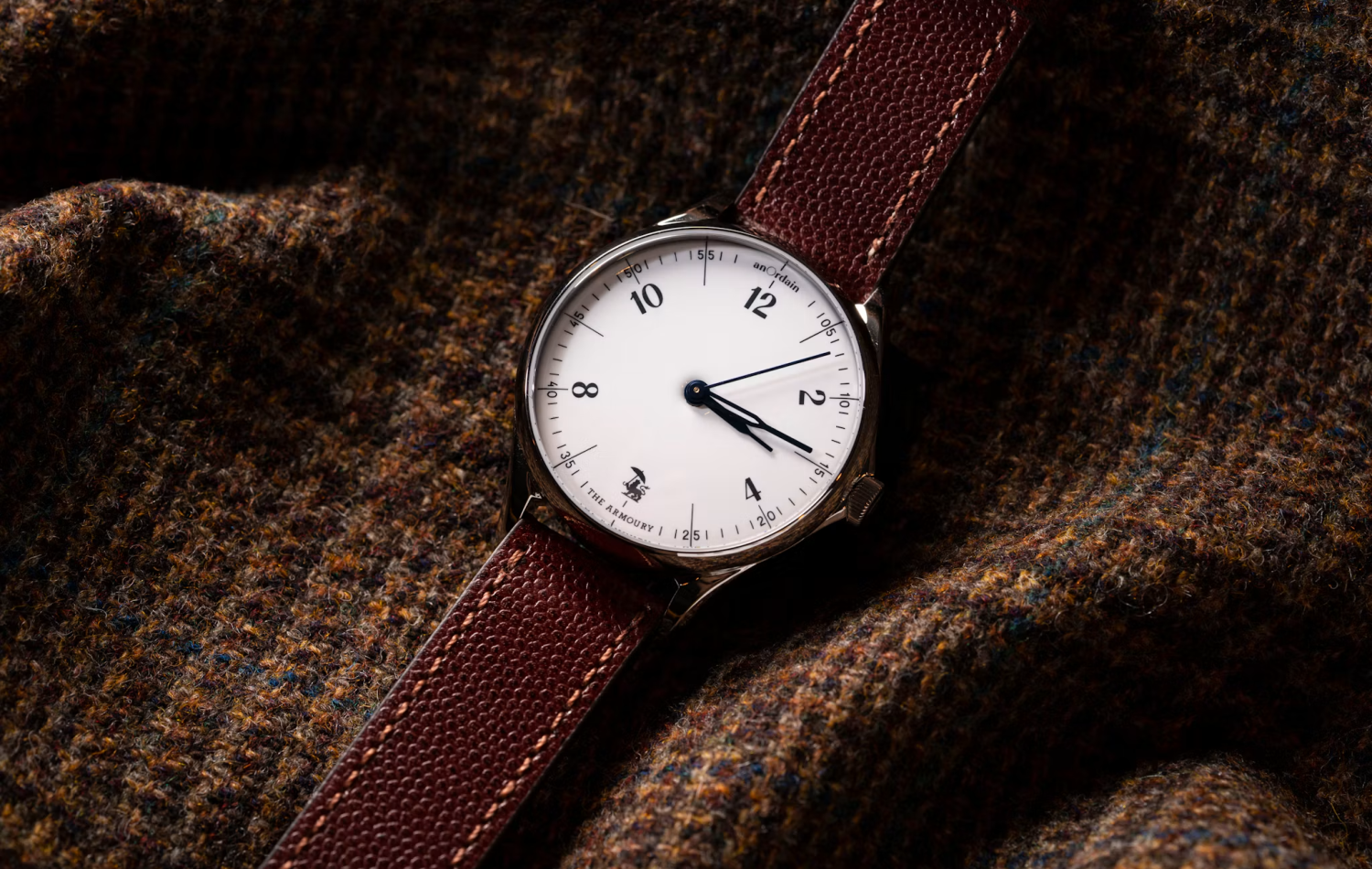
In the world of high-end watchmaking, enamel dials have always carried a certain “old-world” arrogance. They are expensive, fragile, and produced in extremely small quantities, and have long been dominated by names like Patek Philippe and Vacheron Constantin. For a brand newly established and only a few years old from Scotland to produce enamel watches, it sounds like a rather unwise decision. But anOrdain did exactly that, and it succeeded. The founder, Lewis Heath, was originally an industrial designer. While fishing in Loch an Ordain in the Scottish Highlands, he came up with this idea, and the brand was thus named. When the first watch was launched in 2018, the entire team consisted of only six people, and it took three weeks to produce a batch of dials. Now, the waiting list for anOrdain has extended to several years later, and its enamel watches have become items that require a premium price to obtain on the second-hand market.
Starting from scratch, firing enamel in Glasgow
The most distinctive feature of anOrdain is that its enamel dial is not a semi-finished product purchased from Swiss or French suppliers. All the enamel processes are completed manually in the workshop in Glasgow.
This was almost a forced choice at that time. Heath tried to find a workshop in other parts of the UK that could produce enamel dials, but found that no one could meet the precision requirements and no one had the patience to try. So he decided to do it himself. The three enamelists in the team were originally jewelry designers. Before the brand was officially launched, they spent a full three years learning enamel dial technology. Making an enamel dial requires repeated firings in the furnace, with temperatures reaching approximately 830 degrees Celsius. Each time it is taken out of the furnace, bubbles, impurities, and thickness need to be checked. In the early days, the entire team could only produce 8 qualified enamel dials per week. Later, it gradually increased to 14 to 15. Such production capacity is insignificant compared to that of large factories in Switzerland, but it is precisely this “not fast enough” pace that gives each anOrdain dial a touch of handcrafted quality.
Colour, is the letter from the Scottish Highlands
What truly makes anOrdain stand out is not “what kind of enamel it produced”, but “the color of the enamel it produced”.

Most brands follow a classical approach for their enamel plates: pure white, cream white, deep blue, and black. However, anOrdain’s palette is directly sourced from the natural landscape of Scotland. The “Torr Blue” in the Model 2 series is derived from the blue color of distant mountains in the mist, “Midnight Green” comes from the never-complete darkness of the sky on the Kane Gorm Mountains at night, and “Moss Green” is inspired by the peat moss covering the peat bogs in the highlands. There is also a model called “Orange Fumé”, whose orange enamel, after being fired on the silver base, presents a subtle double rainbow effect. When viewed from the front, it is a solid orange, but when rotated, it reveals the silver luster beneath.
These colors are not randomly mixed. Each enamel formula has its own unique temperament. The firing parameters for one enamel to be successful may not work for another color. The enamel artisans at anOrdain spent over 4,000 hours experimenting on the jewelry workbench during the摸索 stage to stabilize these colors. This “paying with time for colors” approach allows the dials of anOrdain to have a depth that is difficult to replicate in Swiss mass-produced enamel: the colors seem to come through from beneath the metal rather than being covered on the surface.
Smoked enamel: A technique discovered through personal experimentation
AnOrdain repeatedly mentioned one thing in the competition materials of GPHG: They developed a “completely new enamel technology” to create smoked gradient dials.

The traditional method of making smoked dials is to apply a layer of semi-transparent black paint on the dial surface, gradually fading from the edge to the center. AnOrdain’s approach is different. They directly applied enamel onto a hand-forged curved silver disc, and created the gradient effect by controlling the thickness of the enamel in different areas. The thickest part is only 0.4 millimeters, and the thinnest part is 0.15 millimeters, with a difference of less than the diameter of a single hair. Operating at such a precision, even the slightest mistake could cause the enamel to crack during the firing process. But once it was done, the effect was astonishing. The Green Fumé of Model 2, under the light, presents a texture like “cosmic starry sky”, with dark green as the base color, and faint light points peeking through, as if coming from within the dial.
The Imperfect Perfection
The dial of anOrdain has a subtle “imperfection”, and this imperfection is precisely what makes it most charming.

The hand-painted enamel on each piece has subtle differences in color and texture. When two watches of the same color are placed together, upon closer inspection, you will notice that the gradient positions, shades, and even the surface textures are not exactly the same. For industrial products that strive for absolute consistency, this is a defect; but for a hand-painted enamel watch, it is a proof of identity. The dial on your wrist is something that someone made by hand on a particular day. It cannot be perfectly replicated.
This temperament also extends to the case and hands. The steel cases of Model 1 and Model 2 have been hardened, making them more scratch-resistant than ordinary stainless steel, but the surfaces remain plain with brushed or polished finishes, not overshadowing the dial. The hands are treated with heat-treated blue steel or gold plating, slender and restrained, almost deliberately giving the viewer’s attention to the underlying enamel layer. The font on the dial is not chosen randomly; anOrdain has a dedicated font designer who draws inspiration from old topographic survey maps of the Scottish Highlands and designed two complementary but distinguishable fonts for the hour markers and minute divisions.
What did it change?
The meaning of “anOrdain” does not lie in it creating “an enamel watch better than Patek Philippe”. It did not do so, and it did not need to.

Its significance lies in that it has brought a craftsmanship that originally required tens of thousands of yuan or even more to reach, to a price range that young watch enthusiasts can seriously consider. The basic Model 2 is priced under two thousand pounds, and even the most complex Model 3 Method is priced around five thousand dollars. Behind this is a completely different logic: not relying on brand history premiums, not relying on precious metal embellishments, spending money on the dial, and making the dial so attractive that people are willing to wait in line for several years.
Before anOrdain, enamel dial watches were “things for collectors”. After anOrdain, it can also be a daily wear for a young person who likes colors, likes craftsmanship, but does not want to pay the down payment for a house. From this perspective, what this small team from Glasgow has done is more interesting than what many big brands have done in the past two decades.
Conclusion: The Scottish micro-brand with pure craftsmanship genes
Whether you are attracted by the grandeur of Patek Philippe’s rare craftsmanship or fascinated by the classic elegance of Vacheron Constantin’s micro-painted enamel, anOrdain offers a sincere and warmer way to experience the same traditional handicraft.
It is not a cheap imitation of traditional Swiss enamel, but rather an independent response presented by a group of designers who deeply understand the beauty of colors and mechanics, in the Glasgow workshop. Often, this tiny micro-brand with extremely limited production runs has more uniqueness, greater vitality, and is more capable of telling a charming story about the Scottish Highlands and the meticulous craftsmanship of slow production.
