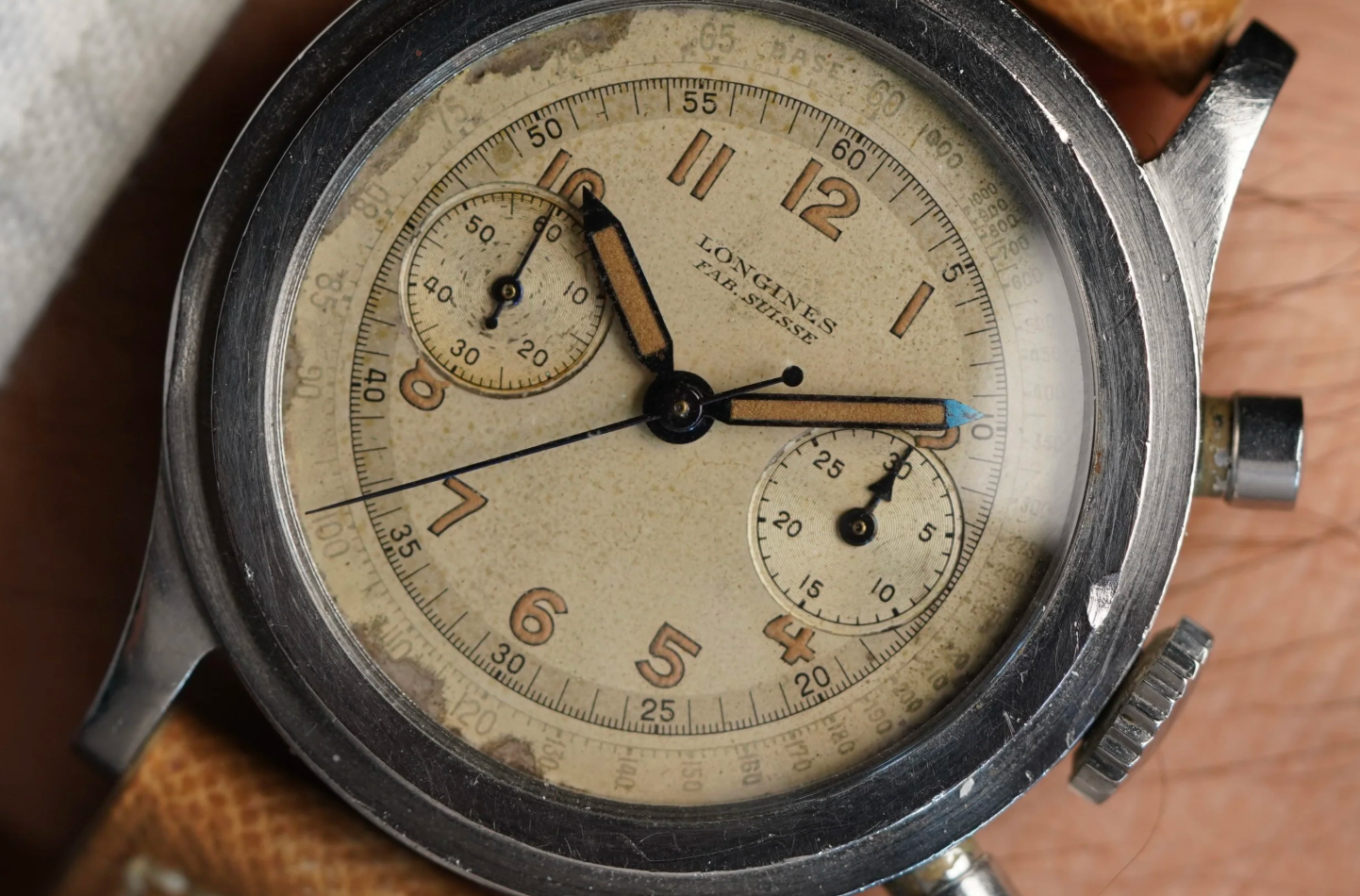
In the 1930s and 1940s, when Patek Philippe and Vacheron Constantin were still purchasing semi-finished chronograph components from professional watchmakers, Longines had already been manufacturing complete chronograph movements on its own. 13ZN was a powerful blow in the history of watchmaking of that era. However, later on, Longines discontinued this line of production on its own.
In today’s watch market context, Longines is synonymous with “entry-level Swiss watches under 10,000 yuan”. Master Craftsmen, Conquest, Pioneer – these brands follow a cost-effective approach. But if you go back to 80 years ago, Longines had a completely different identity: it was one of the few manufacturers that could produce chronograph movements on its own, and 13ZN was its sharpest tool.
In 1936, a “clockwork mechanism that shouldn’t have appeared so early”
The 13ZN was born in 1936. That year, Longines not only introduced this movement but also obtained the patent for the flyback chronograph mechanism.

Its specifications were top-of-the-line at that time: column wheel plus horizontal clutch, 17 jewels, 18,000 vibrations per hour, a diameter of 29.8 millimeters, and a thickness of 6.05 millimeters. The pressing feel brought by the column wheel structure is crisp and neat, completely different from the softness of modern cam chronographs. Sotheby’s directly called the 13ZN “one of the best chronograph movements in history” in the auction description.
More importantly, the “in-house production” aspect. In that era, most brands purchased semi-finished movements from Valjoux or Lemania and then assembled them, while Longines had been manufacturing chronograph movements since the pocket watch era. The 13ZN was the pinnacle product of this in-house production route. The interweaving of plates and the stacking of levers, the complexity and beauty of which can only be seen in the complex models of top brands today.
Two versions, two playing methods
The 13ZN has two distinct versions, each with its own die-hard fans.
The core selling point of the regular version is the return function. For a regular chronograph, you need to press three buttons: start, stop, and reset. With the return function, you only need to press once, and the chronograph hand directly resets to zero and starts anew. This feature is particularly important for pilots – in the air, a second is as valuable as a second. Christie’s once auctioned a steel 13ZN with a return function from 1942 (Ref. 4443), with a double-color silver dial and a blue speedometer ring, and it sold for 81,900 Hong Kong dollars.

The special edition took a more bizarre path. It doesn’t have the return function, but it has made the minute counter into a central large hand – red, thick, and running in the same axis as the blue seconds hand. The small minute hand at the 3 o’clock position was changed to a 12-hour cumulative hand. This design was unprecedented at that time and no other brand has done it today. The collector gave it an Italian nickname: “Doppia Lancetta”.

Sotheby’s auctioned a steel “Doppia Lancetta” Ref. 5699 from around 1945, with a diameter of 39.5 millimeters – it was a giant size for that era. The description specifically mentioned that “at first glance, it looks like a split-seconds chronograph, but the red central hand is actually the cumulative minute hand”. This visual deception is precisely what makes it most fascinating.
Why was it forgotten?
The 13ZN is an “over-engineered” movement.
Its functions are too complex, its structure is too precise, and its cost is too high. Tourbillon, escapement, central minute hand – each of these features is pushing up the manufacturing costs. Longines soon realized that selling this movement would result in losses. So in the 1950s, they introduced the 30CH, a simpler, cheaper, and more suitable mass-production chronograph movement, replacing the position of the 13ZN.

A greater turning point occurred after the quartz crisis. Longines was acquired by Swatch Group, and the brand positioning was redefined: it was given to Omega at the top end, and they took a mid-range route themselves. The history of producing their own chronograph movements was thus interrupted. Today’s Longines chronographs use ETA universal movements.
So the 13ZN became a fractured legacy. It does not belong to Longines today; it only belongs to that Longines that still made its own movements in Saint-Imier.
The “leaks” and “holes” in the auction venue
The auction prices of 13ZN are extremely polarized.
The regular steel version of 13ZN may fetch around $5,000. However, the rare “Doppia Lancetta” steel version can command prices of tens of thousands of dollars. In 2025, a Longines watch listed on Goodwill as a “repair part” finally sold for $88,197 – it was later identified as Ref. 5699 “Doppia Lancetta”, with only about 250 examples of this steel model in existence.

This case illustrates the true status of 13ZN in the collecting community: those who understand it are willing to pay exorbitant prices for it, while those who don’t view it as anything valuable and sell it off as junk. Its value does not depend on the current marketing narrative of the brand, but solely on the historical weight and availability of the movement itself.
Conclusion
13ZN is a pocket watch mechanism that has been forgotten by time, not because it is not good enough. On the contrary, it was abandoned by Longines itself because it was too good, too expensive, and too uncompromising.
Today, if you see a Longines watch with 13ZN on the auction catalogue, the dial still bears the emblem of the winged hourglass. It won’t tell you which officer or pilot this watch once belonged to, nor will it tell you how advanced this mechanism was in 1936. It just quietly ticks away, with the column wheel engaging, the flyback returning to zero, and the central red hand turning in circles.
Longines later produced many cheaper and more popular watches. But 13ZN proved one thing: This brand once had the ability to produce one of the best chronometer mechanisms in the world. It just chose a different path.
