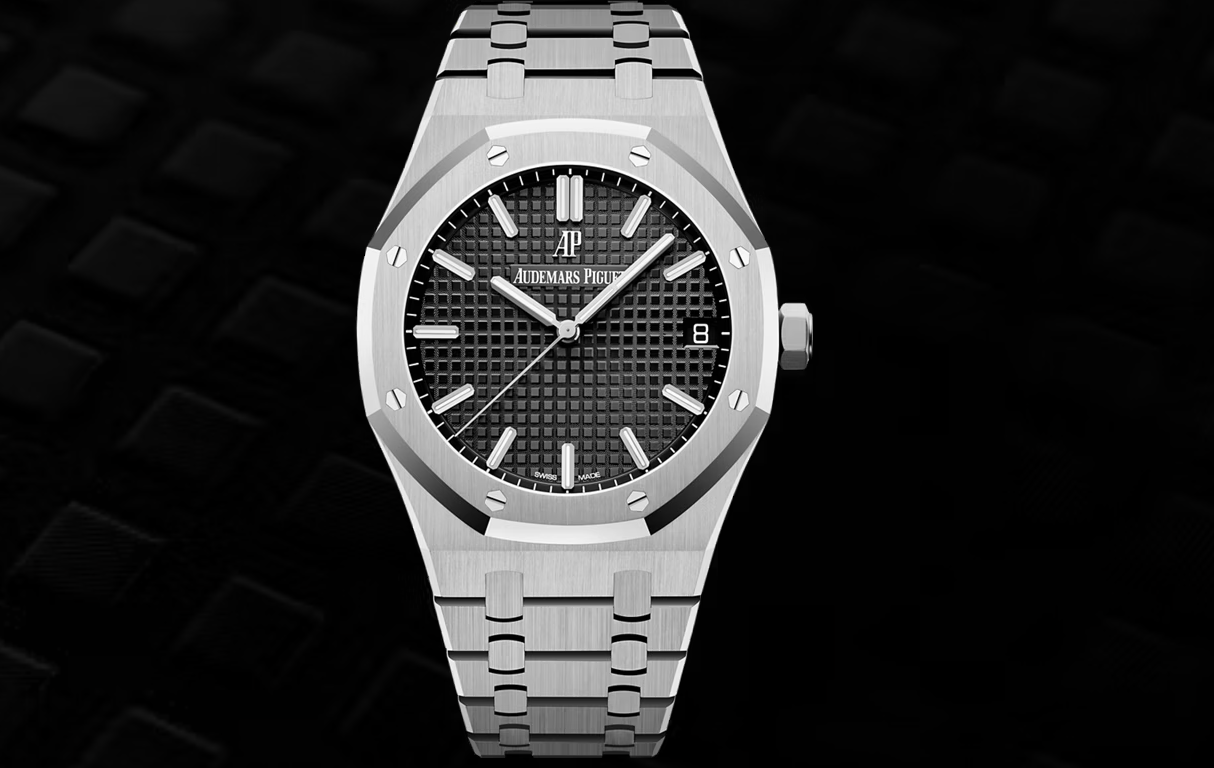
In the history of high-end watchmaking, few watches have experienced such a dramatic rise and fall as the Royal Oak. When the first generation of Royal Oak was introduced in 1972, the critics almost unanimously called it “horribly ugly” – the octagonal bezel, exposed eight screws, and the integrated steel bracelet, all of which seemed crude, industrial, and not at all like a high-end watch.
However, time provided a different answer. The Royal Oak not only survived but also became the originator of the contemporary market logic that “steel watches are more expensive than gold watches”. And 15500 is the answer this lineage delivered in 2019.
It didn’t invent anything new; it merely advanced the classic concept by one step

15500 is the successor of 15400, and 15400 in turn is the direct descendant of the original Royal Oak. This line has lasted for nearly fifty years, but what 15500 actually did was quite restrained: it did not change the soul of the Royal Oak, but made that soul more suitable for this era.
The most noticeable changes are on the dial. The 15500 removes the “AUTOMATIC” inscription at the 6 o’clock position, while the “AP” logo at 12 o’clock has been enlarged. The hour markers and hands are now thicker, the date window has been shifted closer to the edge of the dial, and the minute track has been moved from the textured surface to the outer flange. While each of these adjustments might seem insignificant on its own, taken together, they make the dial of the 15500 appear more expansive and “larger” than that of the 15400—even though both models share the same 41mm case diameter.
This “feeling of being larger” is precisely the smartest part of 15500. It retains the iconic “Grande Tapisserie” large-grain dial of the Royal Oak, the octagonal bezel and those eight exposed screws, but through fine-tuning the proportions, the entire watch has more presence on the wrist. The rebellious spirit of the original Royal Oak is re-expressed by 15500 in a more mature way.
4302 movement: From “Large Watch, Small Movement” to “Large Watch, Large Movement”

The 15400 model has a problem that has been criticized by watch enthusiasts for many years: the diameter of the 3120 movement is only 26mm, and it is installed in a 41mm case. When viewed through the back, the movement appears cramped and there is too much white space around it, commonly known as “a large watch with a small movement”.
The 15500 model has been equipped with the Calibre 4302 movement, with the movement diameter expanded to 32mm. Finally, it fills the 41mm case. This movement has 257 parts, 32 gemstones, a vibration frequency of 4Hz, and a power reserve of 70 hours. You can wear it for two days on the weekend and still keep running on Monday. No need to reset the time.
The movement’s architecture is more complex than that of the 3120, featuring a greater number of individual bridges and a larger openworked automatic rotor, which significantly elevates the visual appeal when viewed through the case back. For a steel watch with a retail price exceeding 200,000 RMB, the visual and performance specifications offered by the 4302 serve as a key foundation for sustaining its premium in the secondary market.
Steel watches were sold at the price of gold watches
The most talked-about topic about the Royal Oak 15500 is undoubtedly its price.

The official market price is approximately 240,000 RMB (with slight fluctuations in different channels and periods). However, in the secondary market, the recycling price of the blue dial 15500ST has remained stable between 230,000 and 280,000 RMB, with a preservation rate ranging from 105% to 127%. That is to say, a wristwatch made of high-quality steel, with large hour markers and a calendar function, has performed better in the second-hand market than most brands’ complex precious metal models.
This phenomenon was unimaginable before 1972. In that era, steel watches were considered as tools, while gold watches were regarded as high-end watches. The Royal Oak broke this rule with its octagonal bezel and integrated steel bracelet, and the 15500 proved that this rule still holds true to this day. The blue dial has become a “hard currency” because the second-hand market price of the blue dial is usually 15% to 30% higher than other colors, making it suitable for both formal and casual occasions, and there are the most buyers when it is sold.
Of course, the 15500 has been discontinued, and the available stock in the market is limited. Its successor, the 15510ST, has a similar official market price, but the popularity and premium space in the secondary market are not as good as that of the 15500. For those who want a “classic Royal Oak”, the 15500 blue dial is a choice that has been repeatedly verified by the market.
What does it feel like when it’s worn on the hand?

The watch has a diameter of 41mm and a thickness of 10.5mm. This size is not overly large for today’s sports watches, but the integrated steel bracelet of the Royal Oak makes it stand out more on the wrist compared to the numbers alone.
The polishing of the bracelet is a hallmark of Audemars Piguet. The alternating brushed and polished links, the fit to the curvature of the wrist, and the folding clasp with the “AP” logo – every detail reminds you that this watch has put in a lot of effort in the “steel” material, no less than any gold watch. The screw-in crown provides 50 meters of water resistance, allowing you to go about your daily activities without having to take it off, but don’t wear it for swimming – the actual meaning of 50 meters of water resistance is something you’ll understand.
The eight screws on the bezel were once evidence of an “industrial feel” in 1972, but today they are the most distinctive design language. You don’t need to look at the logo on the dial; three meters away, seeing those eight screws and the octagonal outline, you’ll know it’s a Royal Oak.
Conclusion
15500 is not a “revolutionary” watch. It doesn’t introduce any new complex functions, doesn’t revolutionize the material, and doesn’t change the basic outline of the Royal Oak.
However, it accomplished something that has become increasingly difficult in contemporary watchmaking: it refined a rebellious design from fifty years ago to such a degree of perfection that it can still confidently command a higher price than a gold watch today. The first generation Royal Oak relied on courage, while the 15500 relies on transforming that courage into an aesthetic that can be worn daily and withstands the scrutiny of time.
If you want a steel watch that can accompany you to work, meetings, and weekend outings, and still won’t cause you too much loss in the secondary market, the 15500 blue dial is a proven solution. It may not be stunning, but it is durable. And “durable” is much more valuable in the world of watches than “stunning”.
