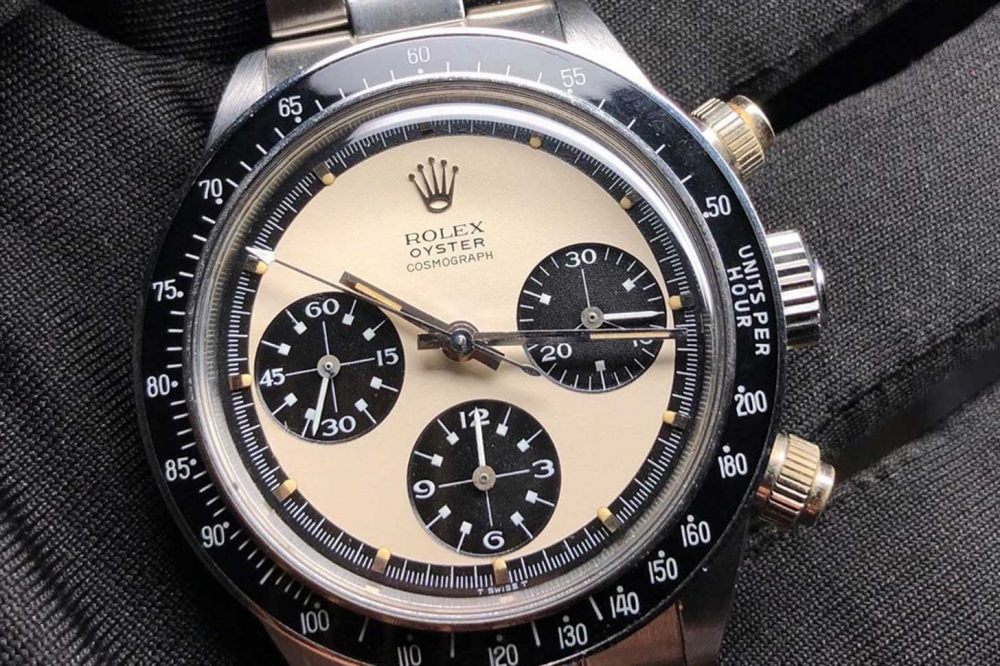
In today’s secondary market, the modern Daytona is a hard currency, with ceramic bezels, automatic movements, and a waiting list. But if you rewind the clock to the late 1960s, the Daytona was still just a timing tool designed for race drivers, sitting in a showcase with no one paying attention. It was the antique models like 6263 that truly made this series “worth something”. It is not the rarest or the most expensive, but it happens to be at a turning point: Rolex first carefully combined “waterproof” and “manual chronograph”, and it was collectors who later realized how attractive this combination was.
The black acrylic bezel is its identity card

The 6263 was launched around 1969, replacing the previous 6240. It was produced along with its sister model 6265 for nearly two decades. The core difference between the two is obvious: the 6263 uses a black acrylic speedometer bezel, while the 6265 uses a stainless steel bezel. This black plastic bezel may seem a bit “cheap” today, but it makes the dial of the 6263 stand out more and more closely resemble the appearance of a racing instrument.
Another key change was the screw-down chronograph button. The previous Daytona used a pump-style button, which had limited water resistance. The 6263 replaced this with a screw-down button and a screw-down crown, truly deserving the “Oyster” logo on the dial. This means you can wear it while washing your hands or getting wet, not just sitting on the track and watching others drive.
The diameter is only 37 millimeters, which is too small for even women’s watches today. But those who have worn an antique Daytona know that this size doesn’t feel cramped on the wrist because the lugs are long, the dial proportion is compact, and it visually appears larger than the numbers.
Valjoux 727: The Final Stop of the Manual Ducaline

The 6263 model is equipped with the Calibre 727 movement, which is an improved version of the Valjoux 72. The oscillation frequency has been increased from 18,000 beats per minute to 21,600 beats per minute, and the power reserve is approximately 50 hours. The horizontal clutch structure controlled by the column wheel has a clean and segmented feel when pressed, which is completely different from the softness of modern automatic chronographs.
This movement holds a special place in the history of the Daytona: it is Rolex’s last manually wound Daytona movement. After 1988, the Daytona was equipped with a Blancpain automatic movement (Calibre 4030), and later it was Rolex’s own 4130 movement. Therefore, the 6263 (and 6265) represent “the finale of the manual Daytona era”. For those who are obsessed with the pureness of mechanical craftsmanship, this identity itself is a form of value.
Those variations that make collectors’ hearts race
The 6263 model has been produced for nearly two decades, resulting in numerous variations of the dial design that could fill a book. Among them, several have become independent legends in the auction market.
The Paul Newman dial is the most distinctive. This dial is named after the Rolex Submariner that Paul Newman wore in the movie “Winning”. Its features include a square chronograph sub-dial, Art Deco-style numerals, and a “step” design on the edge of the dial. A 1969 6263 Paul Newman Panda dial was sold at Sotheby’s for $504,000. However, the Paul Newman dial itself was produced in very small quantities and was discontinued shortly after the 6263 model was launched, so every surviving piece carries the rarity of being the “last exotic dial”.

“Oyster Sotto” is another extremely rare variant. When the 6263 was first launched in 1969, the waterproof Oyster case was new, but the Paul Newman dial was printed for the previous non-waterproof models. Rolex did not reprint the dial but directly added the word “Oyster” on the already printed dial, below “Rolex Cosmograph”, instead of above. There are fewer than 30 known examples worldwide. Christie’s sold one, and it fetched 660,400 Swiss francs.

“Big Red” is more commonly seen. The red text “DAYTONA” is arranged in an arc shape above the six o’clock position of the chronograph dial, giving a very striking visual effect. Christie’s sold a 1976 piece of “Floating Big Red” in 2026, with an auction price of $114,300, which exceeded the highest estimate by 40%.

Another detail worth mentioning is the Sigma dial. If there is a small Greek letter Σ on both sides of “T SWISS T”, it indicates that the hour markers and hands are made of precious metals (usually platinum). Christie’s sold a 6263 Sigma dial in 2026, fetching 576,000 Hong Kong dollars. This detail does not change the timekeeping, but it is proof of “originality” and “configuration integrity”, and collectors are willing to pay more for it.
What does it feel like when it’s worn on the hand?
6263 is not a watch that is suitable for wearing every day. The 37mm stainless steel case is so light that it barely feels on the wrist. The acrylic bezel is not resistant to bumps and the manual winding means you need to interact with it once a day or every other day.
But it is precisely these “disadvantages” that constitute its charm. The screw-in buttons need to be unscrewed before use and the impact of pressing them is accompanied by the distinctive crispness of the column wheel; the acrylic bezel will have subtle scratches in the light, which are the traces of time; the luminous dots on the dial may have turned yellow and black, but that is the natural state after the tritium tubes age, and it cannot be replicated.
In the auction market, the price range of 6263 is extremely wide. An ordinary steel model with a black dial can be acquired for a few thousand Swiss francs; while a Paul Newman dial or an Oyster Sotto can have prices that are ten times or even more higher. This differentiation precisely illustrates the core logic of antique watches: the model is just the ticket, while the dial and configuration determine the ceiling.
Conclusion
The 6263 is not the rarest or the most expensive model of the Tudor Chronograph. However, it happens to be at the end of an era: a manually wound, acrylic bezel, push-button design, and the final breath of the Valjoux movement. After 1988, the Tudor became an automatic watch, a “financial product”, and a name that can never be seen in physical form in the boutiques.
The 6263, on the other hand, remains from that era: a tool made for race car drivers, with speed measurement scales on the dial, and the black plastic bezel shining slightly in the sunlight. It doesn’t know how much it will be worth in the future; it only knows that when you press the button, the second hand will start moving.
