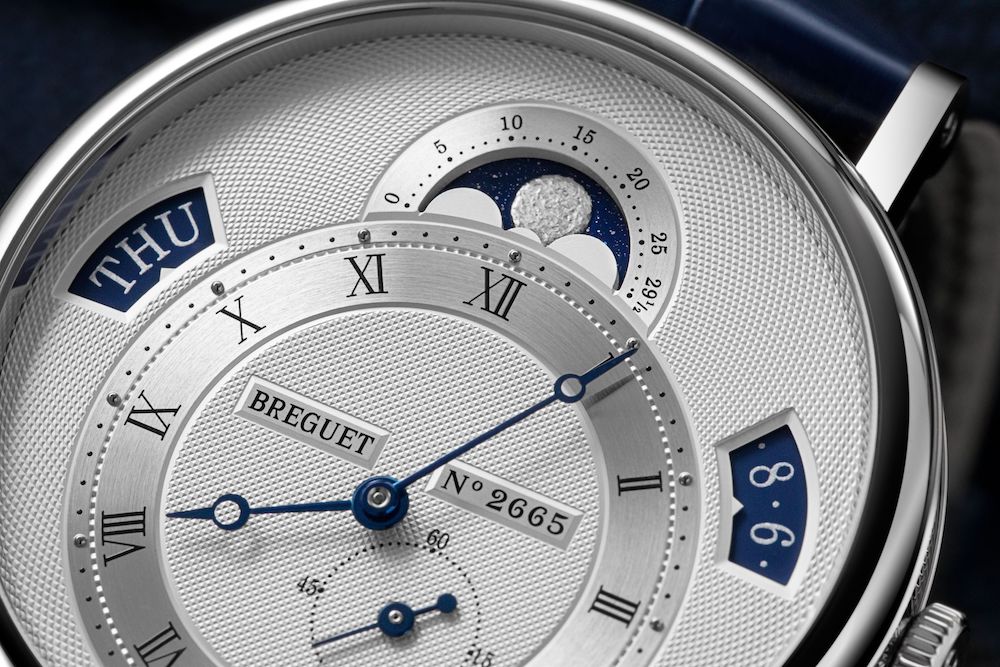
In the world of high-end watchmaking, there is a form of ostentation that involves addition: tourbillons, perpetual calendars, triple alarm functions – one can’t help but cram all these mechanical wonders into a small space. However, the Breguet Classique collection takes a different approach – subtraction. It has no hollowed-out design, no exaggerated windows, and even some models have only two needles – one for hours and one for minutes. But it is precisely this simplest dial that becomes the most ruthless test of a brand’s watchmaking skills. Because when all the embellishments are stripped away, every line, every mark, and every pointer left behind will be subject to the most rigorous scrutiny under a magnifying glass.
The simplicity of our stance stems from the “origin” two hundred years ago

The simplicity of the Breguet Classique series is not the “Nordic style” in the modern design context, but a direct inheritance of the aesthetic rules set by the brand’s founder, Abraham-Louis Breguet, in the late 18th century.
Many elements that are now regarded as “standard features of classic watchmaking” were actually invented by Breguet. For instance, the Breguet hands: featuring a hollow offset ring (apple-shaped hole), with slender needle tips like needles. This design was initially intended to make the timekeeping clearer and more readable in the pocket watch era. Another example is the Breguet numerals: tilted Arabic numerals with subtle serifs. They are easier to read than Roman numerals and more elegant than conventional Arabic numerals.
Moreover, there is the distinctive independent guilloché pattern on the dial. Craftsmen need to manually push the dial on the machine on the back of the dial, allowing the engraving knife to carve out concentric circles or wave patterns as fine as fingerprints on the surface. This process is extremely time-consuming and cannot be replicated because it incorporates the artisan’s hand force.
The reason why the Classique series appears “simple” is that it has retained these classical elements that originally belonged to two or three hundred years ago in their original form. It is not without design; rather, all the designs have become “common sense”.
The simplest layout, the most ruthless magnifying glass

Why is it said that the simplest dials are the ones that test one’s skills the most? Because complex functions can divert one’s attention, while minimalist dials have nowhere to hide.
In the Classique series, the most classic and challenging ones are those with large enamel dials. The essence of large enamel dials is glass, which needs to be repeatedly fired at temperatures above 800 degrees Celsius. The pure white enamel discs are the most difficult because any impurity, bubble, uneven thickness, or minor color difference caused by temperature will be clearly visible on the pure white background. Many top brands’ enamel discs have a seemingly smooth surface, but when viewed at an angle, one can see subtle orange peel textures, which is already of a lower quality. And the true top-quality large enamel dials should be like a smooth white jade, without any flaws.
Apart from the dials, there are also the hands. The Breguet hands are extremely thin, especially the tip part, and they are extremely prone to damage during assembly and daily use. But precisely because they are thin, they must remain absolutely straight and rigid. If a Breguet hand shows a slight bend or rough edges under a magnifying glass, the delicacy of the entire dial will collapse instantly.
Not to mention those seemingly ordinary Breguet fonts. Printed scales that are uneven in thickness or offset by even half a millimeter are difficult for the naked eye to immediately notice, but subconsciously, one will feel that “there is something wrong with this watch”. This feeling of “not being able to say exactly what is wrong, but just feeling that it is not high-end” is a direct manifestation of insufficient watchmaking skills.
Hide one’s skills behind an invisible back

Certainly, the watchmaking skills of the Breguet Classique series are not only demonstrated on the minimalist face, but also in the movement when it is flipped over.
A minimalist dial usually means that the thickness can be well controlled, which puts higher demands on the finishing of the movement. The self-winding movements (such as the 502.3 or 581 movements) used in the Classique series retain the traditional hand-engraving patterns of Breguet (Quai de l’Horloge patterns) on the bridge. This pattern requires that the craftsman manually use a carving knife to glide over the metal under a microscope, without any deviation.
The edges of the bridge are polished with chamfering. In Breguet’s movements, chamfering should not only be wide but also have a lustrous appearance like ripples in water. More importantly, Breguet still insists on performing “inner angle” processing at the chamfered areas by hand. Machines can only cut a straight edge, but when encountering internal acute angles at the junction of the bridge, the craftsman must use a special wooden stylus to dip in polishing paste and rub it manually one by one. This extremely costly pure hand-finishing is the bottom line for Breguet as a top brand.
The reverse adherence in the “era of grand displays”

Over the past two decades, the watch industry has witnessed a “big watch trend”: watch sizes have become larger, functions have become more complex, and the display faces have been stuffed with design elements. The Breguet Classique series stands out particularly in this trend.
It adheres to a classic 38mm to 40mm watch size and maintains the “Coins d’Or” (gold coins) side edges of the case – a rolled-edge design that imitates the edge of a coin, which is both anti-slip and reflective. Its thickness is usually within 9mm, just big enough to fit into the cuff of a French shirt.
This persistence has made the Classique series the preferred choice for collectors who are tired of complex functions and seek a pure reading experience. A 5177 high-fire enamel watch, without a calendar, without a day of the week display, only hours, minutes, seconds and date (5177 has a date window). But its status in the eyes of collectors is no less than those complex models with chronograph and tourbillon functions. Because it proves one thing: without any gimmicks, just by proportion, lines and luster, a watch can be so beautiful that it makes people unable to look away.
Final Thoughts
The Breguet Classique series is the best explanation of the phrase “classical watchmaking”.
It does not pursue keeping up with the times; instead, it aims to withstand the test of time. The simplest dial is actually a test without any room for error. Every enamel bubble on the dial, every burr on the hands, and every deviation in the scale, can all be considered flaws. Only by mastering all the basic skills to perfection can one dare to leave large blank areas on the dial.
Therefore, never underestimate a Breguet watch with only three hands. It may seem simple, but in fact, every aspect of it is the accumulated experience and strength of watchmaking over two hundred years.
