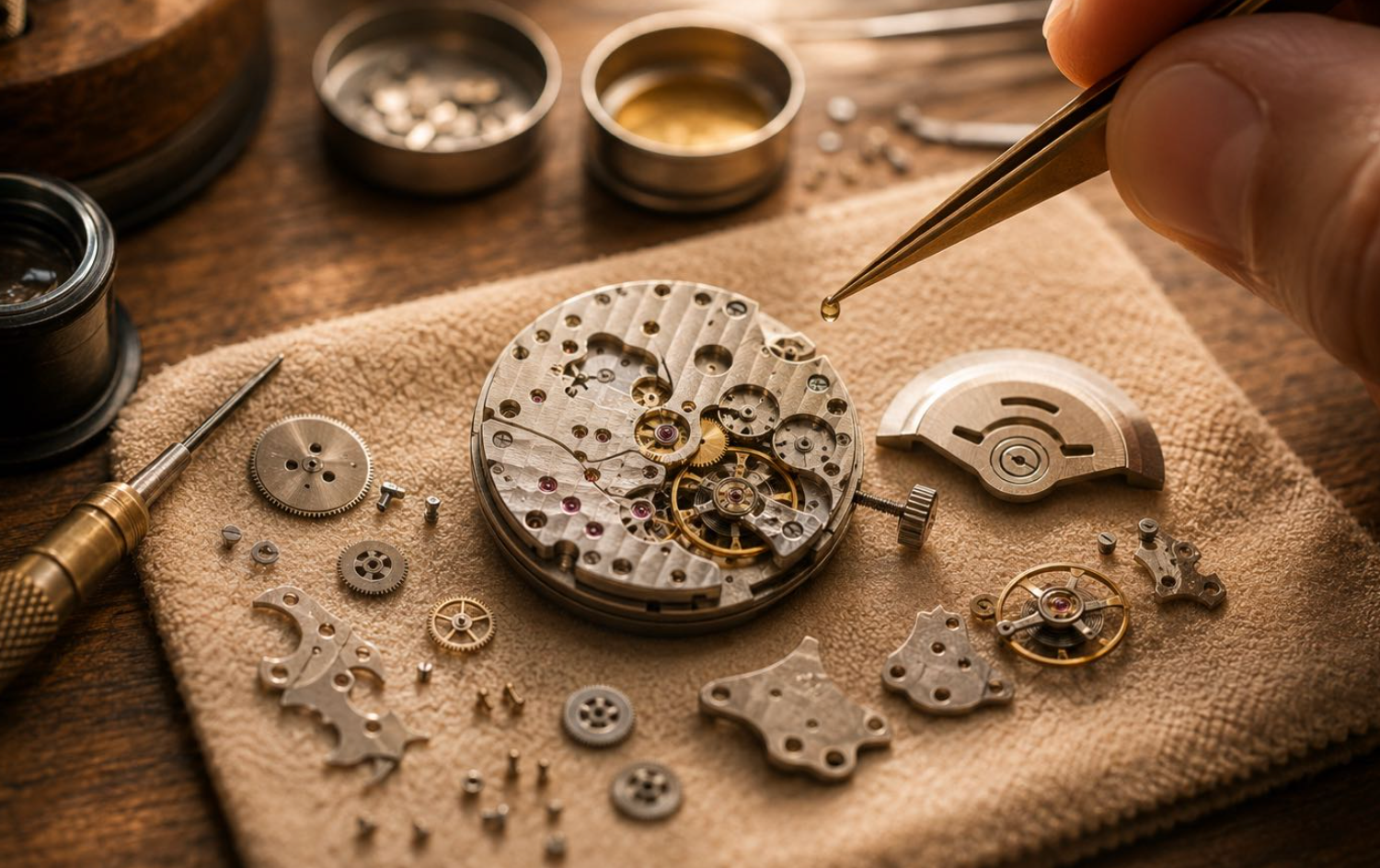
Regarding the oiling of mechanical watches, there have always been two opposing viewpoints within the watch case. One side claims that “the watch needs to be oiled every 3 to 5 years; otherwise, the dried oil will damage the movement.” The other side argues, “My watch has been worn for ten years but has never been oiled. It’s still running smoothly. Don’t go through all this trouble.” Both sides have their merits, and many people have verified this with their own money. The issue is that oiling a mechanical watch is never a one-size-fits-all matter based on time alone.
Why is oil washing necessary?
There are dozens of friction points in the movement that require lubrication. The lubricating oil will oxidize and thicken over time, eventually drying up. Once the oil fails, the metal parts start to rub against each other directly, and the wear begins.
What’s more troublesome is that when the oil dries up, it turns into oil sludge. Mixed with the metal debris worn off, it acts as a grinding agent between the gears and the gemstone bearings. During this stage, the watch may still keep running accurately – because the gears can still be moved, it’s just that each rotation is wearing down. When the timekeeping becomes noticeably inaccurate or even stops, the wear is usually irreversible: the gemstone eyes are ground into ellipses and need to be replaced, and the teeth of the gears are sharpened and the entire gear train needs to be replaced.
So the main purpose of cleaning the oil is not “to make the watch run accurately”, but to replace the aged oil before the wear occurs.
The “standard answers” in the industry and their limitations

Most brands and repair shops recommend a period of 3 to 5 years. The official advice from Seiko is to perform an oil cleaning maintenance every 3 to 4 years. Some watch dealers in Europe say, “Generally speaking, mechanical watches need an oil cleaning maintenance once every three to five years.”
However, this figure needs to be adjusted. Experienced repair technicians point out that the actual cycle is influenced by three factors: wearing frequency (worn watches consume oil quickly, and those worn frequently are exposed to greater temperature differences, causing the oil to emulsify faster), usage environment (constant exposure to moisture and temperature fluctuations leads to faster oil deterioration), and movement grade (high-end movements use synthetic oil which has better stability and higher processing accuracy, allowing for maintenance intervals of up to 5 years or even longer).
A widely cited example is: The Rolex Submariner in black color from 2015. When the new owner bought it in 2024, the time difference was +12 seconds and the amplitude was 265. He didn’t rush to have it serviced. After wearing it for half a year, the time difference dropped to +18 seconds, and he sent it to the official for an oil cleaning. If he had serviced it right after purchasing, those 4,000 yuan would have been wasted. This shows that time is not the only criterion; the running condition is.
A more reliable method of judgment than “how many years have passed since wearing it”

If you want to know whether your watch really needs oiling or not, the most straightforward way is to measure the data with a calibration device. Ordinary watch enthusiasts can spend a few hundred yuan to have it checked at a reputable watch store, which is much more reliable than guessing.
The key lies in two indicators: the daily error and the amplitude. Take a Rolex Submariner as an example. For a new watch or one made within the last 5 years, if the daily error is within 5 seconds and the amplitude is above 280, there is no need for maintenance; if the daily error is within 10 seconds and the amplitude is around 270, it can be observed further; if the daily error is above 15 seconds and the amplitude drops below 250, it’s time to oil the watch.
The amplitude is more sensitive than the daily error. Oil aging is gradual, and the watch’s timing may remain normal even slightly faster before completely failing. However, the amplitude will drop honestly. When the amplitude drops from 300° to below 230°, it is basically a signal that the lubricating oil can no longer support the watch.
Another simple method is to record the timing error. Continuously record for a week. If the error remains within the normal range, don’t bother. Watches often have problems that are artificially caused by excessive oiling.
What’s the situation? It can’t wait and needs to be dealt with immediately

There are three situations where time is not an excuse:
1、Water has entered. The display mirror is fogged up and there are water droplets on the crown. It needs to be repaired within 24 hours. The movement is rusting much faster than you might think.
2、After being dropped, the timekeeping suddenly changed. Send it for inspection immediately. Don’t wear it.
3、It hasn’t been maintained for over 10 years. Even if the timekeeping is normal, it is recommended to clean and apply oil because the lubricating oil is likely to have dried up or solidified, although it is not yet at the stage of “causing problems”.
As for watches that are not worn for a long time, some people believe that leaving them untouched won’t cause wear and thus no maintenance is needed. However, the oil will deposit and solidify over time, making it more likely to get stuck in the shaft holes; the sealing gasket will also age. Therefore, before wearing a long-stored watch again, it is best to manually wind it for a few days to observe the timekeeping. If there is anything wrong, send it for inspection.
What exactly does the degreasing process remove?
Many people think that “washing oil” means “removing the old oil and replacing it with new oil”. In fact, a complete oil-washing maintenance process is much more complicated than that:
The movement is completely disassembled into individual parts, including the main plate, gear system, escapement system, and balance wheel hairspring; using a professional ultrasonic cleaning machine combined with cleaning solution, old oil, dust, and metal debris are removed. This process is usually repeated 2 to 3 times; inspect each part, replace those that are worn or damaged (commonly replaced parts include waterproof gaskets, springs, and gears); reassemble and add special lubricating oil to key areas, and the amount of oil at each injection point needs to be precisely controlled; finally, use a timing tester to check the accuracy of the timekeeping and conduct a waterproof test.
The core difficulty of the entire process lies in applying the oil to the right places. Using different oils for different areas and controlling different amounts of oil is crucial. If not done carefully, the timekeeping data can be completely different. That’s why maintenance technicians generally do not recommend that people do it at home – without a dust-proof environment, disassembly and assembly may lead to dust entering or damaging the sealing ring.
Final Thoughts
Back to the original question: How often should a mechanical watch be oiled?
If you want a convenient number, 3 to 5 years is a reasonable reference range. But it’s not an absolute rule. Watches worn every day can be adjusted towards 3 years, while those worn occasionally can be adjusted towards 5 years. Synthetic oil for high-end movements can last even longer.
If you want a more reliable answer, look at the data. Measure the oscillation amplitude once and record the timekeeping for a week. This is much more useful than simply checking the calendar to figure out “how many years it has been since it was bought”.
If you want the most cost-effective answer, wait until it breaks before oiling it. But the cost might be: a few hundred dollars for oiling could turn into several thousand dollars for replacing the parts.
Oiling a watch is essentially a choice: Are you willing to pay for “prevention” or are you willing to pay for “repair”? There is no right or wrong; it’s just a matter of which one you are more comfortable with.
