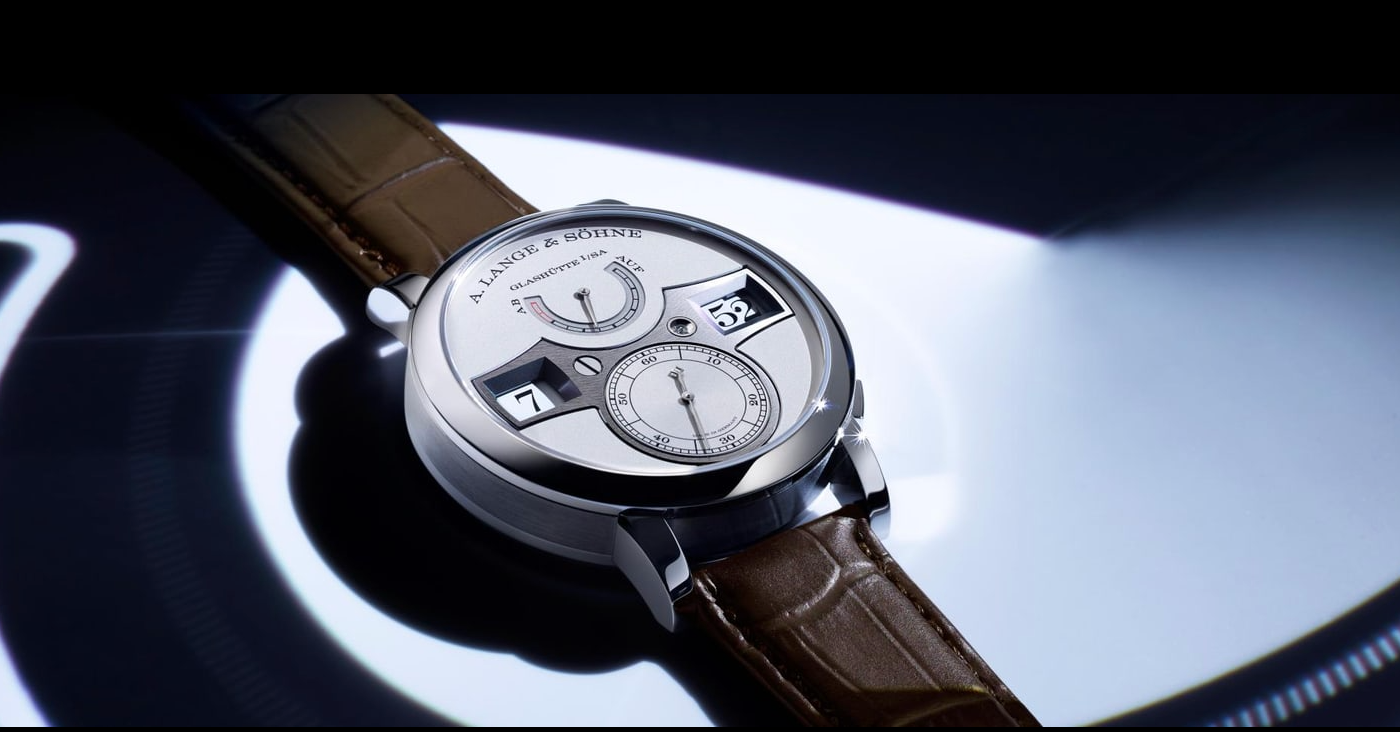
When all other brands were drawing hands on their dials, Lange chose to turn time into numbers. Not electronic numbers, but pure mechanical jumping digits. This piece, called “The Owl” by watch enthusiasts, is perhaps the most stubborn “rebellion” in contemporary watchmaking.
The first time you put a Zeitwerk on your wrist, there will be a moment of disadaptation. When you look down at the watch, you see two side-by-side digital windows, the left one for hours and the right one for minutes. From left to right, you can read them at a glance. There are no hands to follow, no dial to scan, and time is presented to you in an almost “rough” manner. But behind this “roughness” lies the hard nut that Lange spent over a decade to crack.
The face of the owl is the exposed part of the mechanism
The name “Owl” comes from the German silver plate that spans across the center of the dial. Lange calls it “Time Bridge”.

It is not just decoration. This bridge plate is itself part of the movement structure. It frames the two left and right numeral windows, supports the power reserve display above, and surrounds the small seconds hand at the six o’clock position. The two large windows are like two eyes, the small seconds hand is like a mouth, and the screw in the center of the bridge plate and the sapphire bearing are like nostrils – a face is thus formed.
Using German silver for the dial components is a common practice of Lange. This material gradually oxidizes over time, changing from silver-white to a warmish grayish gold. The longer you wear it, the less it resembles an industrial product and more like something touched by time.
Just jump once. How difficult can it be?

Mechanical watches have digital displays, which sounds simple. But doing it is almost a nightmare.
The hands are light and easy to turn. But the digital disc is heavy, and it needs to perform three actions in an instant: acceleration, jump, and stop. Lange’s approach is to use three separate discs: a large hour circle, and two minute discs (tens and units). Every full minute, the constant power escapement system triggers a jump, and the three discs switch within a fraction of a second.
The problem is that the jump requires releasing a huge amount of energy instantly. If the energy comes directly from the mainspring, the spring releases energy forcefully when it’s full and fails to release energy when it’s loose. Lange’s solution is the constant power escapement system: it acts as a “buffer pool” between the mainspring and the jump mechanism. Regardless of the spring’s state, the energy released to the jump mechanism each time is constant.
Another detail: After the jump, the digital disc cannot “land hard”. Lange added a wind wheel regulator to absorb excess energy, allowing the disc to be gently “caught” after the jump is completed instead of hitting the limit. This design is called “buffer landing”, which sounds like a car suspension system, but it is actually the key to ensuring the long-term stable operation of the movement. It jumps 1440 times a day. It jumps 520,000 times a year. Each time requires the same crispness and precision.
What does it feel like when it’s worn on the hand?

The current size of Zeitwerk’s watch is 41.9 millimeters in diameter and 12.2 millimeters in thickness. This size is relatively large for formal watches but smaller for sporty ones, fitting precisely in a position that is noticeable yet not cumbersome. The platinum version has a distinct weight, and those accustomed to steel watches will immediately feel the density.
The crown is at the 2 o’clock position instead of the conventional 3 o’clock. Lange’s explanation is that this position is more comfortable and, from an engineering perspective, the winding system needs to bypass the date display. In practice, the 2 o’clock position of the crown is indeed more convenient to use, especially when the wrist is moving, and it won’t rub against the back of the hand.
The power reserve display is at the 12 o’clock position, represented by an arc to indicate the remaining energy. When the power reserve is less than 12 hours, the scale turns red. For a manual-winding watch with a large energy consumption for the date display, this indication is very practical. The second-generation movement has increased the power reserve from 36 hours to 72 hours. If you don’t wear it for two days on the weekend, it will still jump on Monday when you pick it up.
It may not please everyone, but that is precisely what makes it valuable

The Zeitwerk is not a watch that “at first glance, one wants to buy it”. It lacks the decorative elements of a traditional dial and the flowing sensation created by the movement of the hands across the dial. The way it displays the time is too straightforward, to the extent that some people might think “This doesn’t seem like a high-end watch”.
However, precisely because of this unappealing aspect, it has become the most distinctive product in Lange’s product line. The Lange 1 reorganizes the information using an offset dial, the Datograph showcases the beauty of the movement with its chronograph function, and the Zeitwerk does something even more fundamental: it redesigns the act of “reading the time” itself.
Mechanical watches no longer need to be responsible for “reading the time” in today’s world. Mobile phones are more accurate, brighter, and more convenient. But the existence of Zeitwerk reminds us of one thing: the way of reading the time itself can be an expression. Using a purely mechanical drive for the digital jump, taming the instantaneous release of energy with constant power, and framing all of this in the center of the dial with a German silver bridge plate – this is not catching up with electronic watches; it is paying tribute to “digital” in a mechanical way.
Conclusion
During those few moments when you first got hold of the owl watch, what was most memorable was not how complicated it was, but the instant when the minute hand jumped from 59 to 00, and the hour hand moved one position at the same time. The entire process was neat and smooth, without any hesitation. That feeling was not like looking at a clock, but more like watching a miniature machine complete an exact ritual.
The hands of the analog watch tell you that time is flowing. The owl watch tells you that time is jumping. Both statements are correct, but the latter does indeed make you want to look at it for a little longer.
