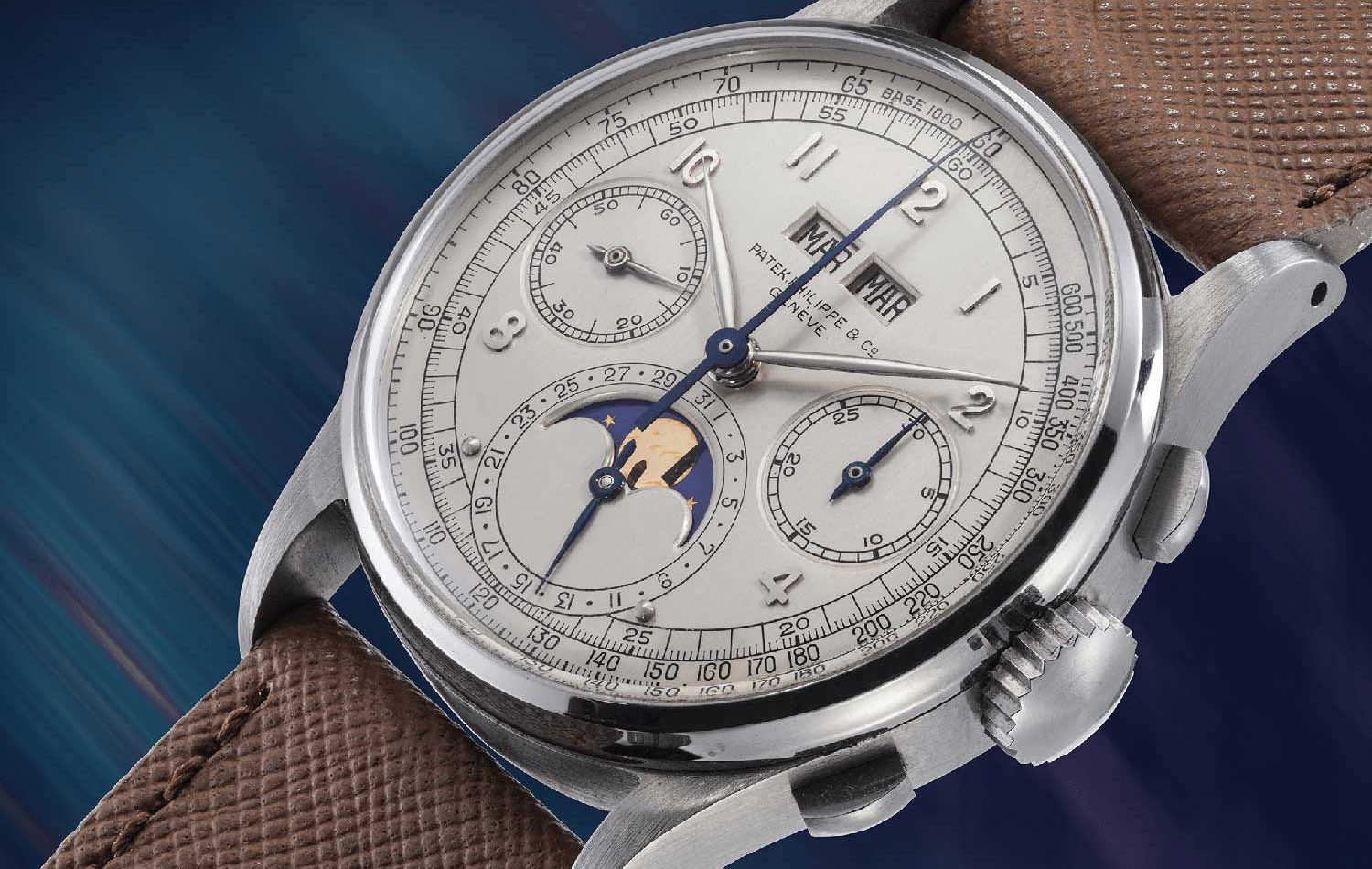
In the world of antique watches, some models succeed based on production volume, while others do so through exceptional design. However, the Patek Philippe 1518 does not fall into either of these categories. It relies on a combination that, in today’s terms, seems almost unimaginable: the most complex mechanism paired with the cheapest materials. When you understand the story behind this combination, you will realize why a steel watch can fetch a hundred times the price of gold at an auction, and why collectors refer to it as “the ultimate peak of collection”.
A “supposedly non-existent” steel watch
In 1941, during the height of World War II, Patek Philippe unveiled the Ref. 1518 at the Basel Watch Show. This was the first chronograph wristwatch in the history of watches to be produced in a series. Before this, chronograph and chronometer were two separate highly complex functions, and integrating them into the same wristwatch was itself a technical adventure.
From 1941 to its discontinuation in 1954, only 281 units of the 1518 were produced. The vast majority were in gold cases, and about one fifth were in pink gold. The stainless steel version, known to exist only in four pieces, remains a mystery to this day.
No one has been able to provide a definite answer as to why these four steel watches exist. The description from the auction house states: “Why Patek Philippe manufactured them remains a mystery.” In that era, stainless steel was typically reserved for entry-level or tool watches, while advanced complex functions were always made of precious metals. Using steel for a chronograph chronometer doesn’t make logical sense.
But it was precisely this “unlogicality” that made it a legend. Phillips Auction House called it “a nearly mythical timepiece, representing the ultimate convergence of historical significance, design mastery, mechanical innovation, and rarity.”
The answers on the board

Regardless of the rarity of the steel casing, the design of 1518 alone is worthy of being recorded in history. The most challenging aspect of complex-function wristwatches is not creating the functions but arranging them neatly. 1518’s solution influenced the layout of the dials of Patek Philippe for the next eighty years: the month and week are displayed in windows, the date and moon phase share a single pointer, and the leap year identification is hidden inside the movement, requiring no additional holes. The speedometer scale is wrapped around the outermost ring, and the overall design is clean, balanced, and not crowded.
The case was made by Emile Vichet SA, with an integrated cold forging process, featuring hard and simple lines, which is a typical representative of the aesthetic style of the 1940s-50s. The 35mm size seems small in today’s perspective, but in recent years, the collecting trend is returning to smaller diameters, and 1518 has thus become more favored.
The movement comes from Victorin Piguet’s perpetual calendar module and is mounted on the Valjoux 13 movement. This combination has been Patek Philippe’s only mass-produced perpetual calendar chronograph solution for nearly half a century, and it was not replaced until the successor 2499 appeared.
The “myth” in the auction house
The history of the 518 auction is itself a condensed history of the antique watch market.

In November 2016, a steel-case 1518 produced in 1943 was sold for 11 million Swiss francs at Furlonge Sotheby’s in Geneva, becoming the most expensive watch ever auctioned at that time. This record was broken by Paul Newman’s Rolex Daytona in 2017 and surpassed by Patek Philippe’s 6300A in 2019. However, the status of the steel-case 1518 has never wavered.
On November 2025, the same steel-case 1518 appeared again at Furlonge Sotheby’s “Decade One” auction. After a bidding process of 9 minutes and 28 seconds and five bidders, it was finally sold for 14.19 million Swiss francs (approximately 17.63 million US dollars). This price not only broke its own record but also made it the most expensive Patek Philippe antique watch ever auctioned. Phillips’ assessment of it was straightforward: “Having a 1518 means that a connoisseur can feel that they have reached the pinnacle of collection.”
Another answer for Pink Gold
Shell 1518 is an “extreme case” of “rarity”, but the collection logic of 1518 is not limited to just one.

Out of a total production run of 281 pieces, approximately 58 are in pink gold. Of these, only 14 examples—featuring a pink gold case paired with a matching pink gold dial—have been identified to date. This “pink-on-pink” configuration represented an exceptionally bespoke choice at the time, with the specific hue of each dial varying slightly due to the handcrafted nature of its creation.
In December 2021, a pink gold pink dial 1518 was sold for 9.57 million US dollars at Sotheby’s in New York, ranking among the top five most expensive wristwatches in auctions. In November 2025, in the same auction, another 1947 pink gold 1518 was sold for nearly 3.57 million Swiss francs.
The steel case is a myth, and pink gold is a taste. Together, they form the complete image of 1518 in the collection world: it is not a “beautiful old watch”, but a historical milestone that must be treated seriously.
Final Thoughts
The reason why 1518 is a legend is not because of its high price. The high price is just the result. The real reason lies in the decision made in 1941: Patek Philippe chose to incorporate the most complex watch functions of that time into a mass-produced framework, rather than making only a few unique pieces to display in the showcase. 281 pieces, each with the same movement, the same layout of the dial, and the same ambition.
Then, by chance, 4 of them were made with steel cases. No one knows why. But it was these 4 “unintended” watches that, eighty years later, made the richest collectors in the world bid on the phone for nine minutes over them.
The most fascinating aspect of antique watches lies in this: the coincidences left by history have more power than any design. The coincidence of 1518 was a piece of steel.
