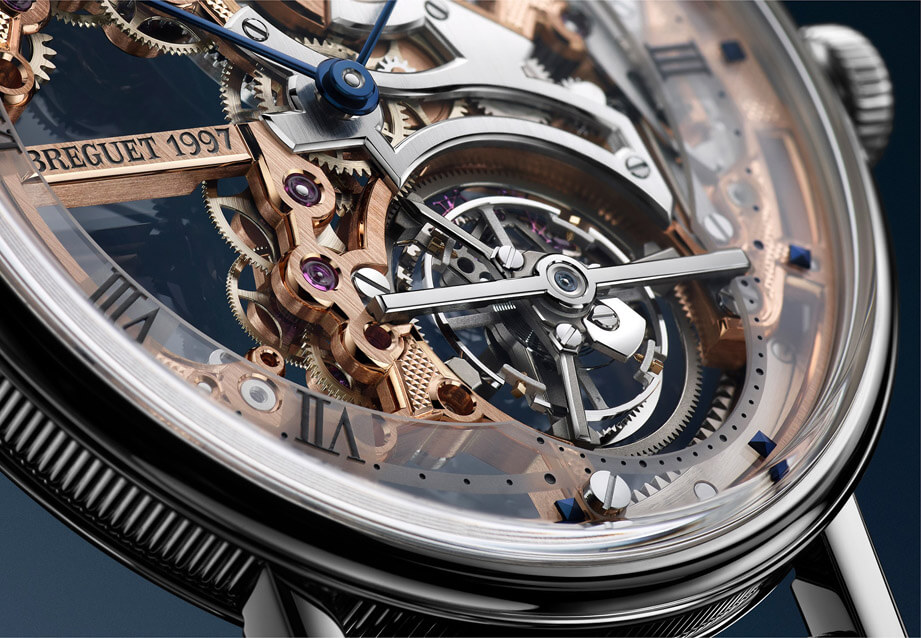
On June 26, 1801, a watchmaker obtained a patent to “offset the influence of gravity on the accuracy of timekeeping”. In the era when pocket watches were hung vertically in pockets, gravity was the most troublesome enemy for watchmakers – the center of gravity of the balance wheel and the hairspring would deviate from the rotation axis, causing the watch to run fast or slow intermittently. Two hundred years later, this invention became the most fascinating symbol of high-end watchmaking.
A problem that has plagued the watchmaking industry for a hundred years
By the end of the 18th century, watchmakers had managed to make pocket watches quite accurate. However, there was one problem that remained unsolved: gravity.
Pendulum clocks were usually hung vertically in pockets or overcoats. In this position, the center of gravity of the balance wheel and the hairspring would deviate from the rotation axis, causing inconsistent timekeeping. Changing the orientation of the pendulum clock would alter the error. This problem was almost an insurmountable physical law barrier at that time, and watchmakers tried every possible method but still couldn’t completely eliminate it.
The person who solved this problem was Abraham-Louis Breguet. He was born in Neuchâtel, Switzerland in 1747. At the age of 15, he began to learn watchmaking and later received systematic education in mathematics and physics at the Marais School in Paris. He was not only a craftsman but also an engineer with theoretical knowledge.
A crazy idea: Make the entire escapement system rotate.

Breguet’s plan seemed almost insane at the time: to incorporate the balance wheel, the hairspring and the escapement mechanism all into one frame, and have this frame rotate continuously.
The logic was this: Since the error comes from “moving faster in some positions and slower in others”, if the components that determine the accuracy of timekeeping are constantly changing positions, passing through those “fast” and “slow” positions every time they rotate, the errors will cancel each other out. Rotating fast enough and regularly, theoretically, gravity would be “averaged out”.
Breguet named this device “Tourbillon”, which in French means “whirlwind” – it describes the combined appearance of the balance wheel oscillation and the frame rotation. On June 26, 1801, according to the republican calendar after the French Revolution, it was “July 7th of the Ninth Year of the Republic”, and Breguet obtained this patent with a validity period of ten years.
The patent lasts for only ten years, but its influence has lasted for two hundred years.

Breguet made an astonishing decision that seems incredible today: he only applied for a 10-year patent for the tourbillon mechanism, and after its expiration, the entire watchmaking industry could freely use this technology.
This was extremely rare in the watchmaking industry at that time. Most watchmakers would lock their key technologies in safes. Breguet’s choice turned the tourbillon mechanism from an individual invention into a common heritage of the entire industry.
However, the tourbillon mechanism itself was not easy to make. From obtaining the patent in 1801 to the first tourbillon watch being sold in 1805, it took four years. Breguet sold only 35 tourbillon timepieces in his lifetime. This number indicates the scarcity of the tourbillon at that time – it was always a symbol of top craftsmanship, rather than a mass-produced product.
Why has it become “a symbol of high-quality watchmaking”?

The tourbillon was invented during the era of pocket watches. In the era of wristwatches, its “practicality” has actually taken a hit – as the wrist moves constantly, the position of the watch is constantly changing, and the effect of the tourbillon in eliminating the influence of gravity is not as crucial as it was in the pocket watch era.
However, this did not diminish the status of the tourbillon; instead, it led it to complete the transformation from a “tool” to a “totem”.
The reason is simple: the tourbillon is extremely difficult to make. A framework consisting of dozens of tiny parts, with a total weight usually less than one gram, needs to maintain precision while continuously rotating. The lighter the framework, the higher the requirements for bearings and gears; the smaller the parts, the greater the difficulty of hand-finishing. The Breguet “Clock Embankment” double-rotating tourbillon wristwatch has 740 parts in its movement, with two tourbillons rotating once per minute and rotating relative to each other once every 12 hours.
Today’s tourbillon

Breguet continues to uphold the tradition of the tourbillon. In 2026, it will mark the 225th anniversary of the invention of the tourbillon. Breguet has released several commemorative pieces. The Classique Classic Series 7357 Tourbillon watch features an optimized version of the 558 movement, continuing the design language of Breguet’s first contemporary tourbillon watch, the Classique 3350, from 1989. The Tradition Heritage Series Tourbillon watch directly adopts the frame structure from the 1801 patent drawing – the cantilever bridge and two support arms, almost retaining the design from two centuries ago.
There is also the Marine Maritime Series 5887 Time Equalizer watch. On the dial, a night-time enamel micro-painting recreates the scene of the Paris night sky on June 26, 1801 – the very day when Breguet obtained the patent for the tourbillon.
The last thing I want to say
The story of the tourbillon is a tale of “solving a problem that seems almost impossible to solve”. Breguet faced gravity and used a rotating frame to “dominate” it. Two hundred years later, gravity still exists and the tourbillon continues to rotate.
It is no longer just a mechanical device. It is a proof – a proof that humans can use precise gears and hairsprings to defy the laws of physics at the microscopic scale. This defiance itself is the most touching aspect of high-end watchmaking.
