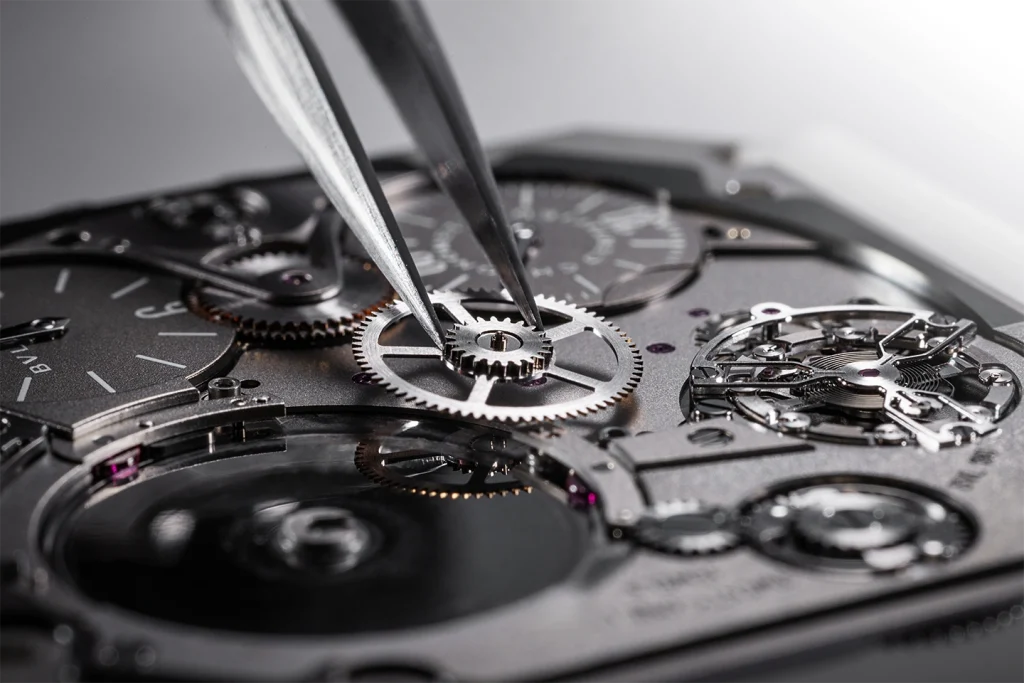
Why can a watch cost tens of thousands or even hundreds of thousands of dollars? Just look at the dial; it might only consist of a few pointers and a few markings. But when you look at the backplate, those interwoven waves, the mirror-like edges and the blue screws are where the watchmaker really spends a lot of money.
Many beginners tend to focus their attention on the dial design, the brand logo or the precious metal material when looking at a watch. But when you actually turn a watch over and examine the movement through the sapphire glass backplate, you will enter the core territory of high-end watchmaking. Watch movement polishing, in the watchmaking world, is called “the grade label hidden in the backplate”. Even for the same movement with accurate timekeeping, whether it has high-quality polishing can make the value differ by ten times or even a hundred times. Today, let’s take a look and dissect exactly where the cost of traditional watch movement polishing lies.
Two polished faces: decoration and functionality
First, it is necessary to clarify a concept: the finishing of the movement is not entirely for “appearing nice”. It is divided into functional finishing and decorative finishing.

Functional finishing is aimed at enhancing the reliability and lifespan of the movement. For example, polishing the gear tooth surfaces can reduce friction and minimize wear; fine grinding of the contact surfaces of the escapement’s gemstone bearings can improve the efficiency of energy transmission.
Decorative finishing, on the other hand, is for aesthetic value, which is what we are focusing on today – the Geneva pattern, fish scale pattern, chamfering (polishing), blue steel screws, and so on. These techniques do not directly improve the accuracy of timekeeping, but determine the position of a watch in the watchmaking pyramid.
So, why are these seemingly “superficial” techniques so expensive?
The key lies in the “touch” that is impossible for machines to achieve
Some might ask: With the advanced technology of today’s CNC machines, can the machines do the job instead? The answer is simple: Machines can create shapes, but they cannot replicate the “soul”.
Take Anglage as an example. This is the “benchmark” that distinguishes mid-range watches from top-end ones. Beveling involves cutting and polishing the original 90-degree straight edges of the clasp into a smooth, small inclined surface. Machines can easily create a 45-degree angle, but the beveling in high-end watchmaking requires the edges to reflect like a mirror and be uniform in width.

More advanced is Inward Angle. At the inner corners where the two clasps intersect, machines cannot directly reach in. Watchmakers must use a specially made yew wood stylus dipped in polishing compound and push and rub it by hand, bit by bit. This part is almost invisible to the naked eye, but top brands (such as Patek Philippe, Lange, and Vacheron Constantin) still insist on completing it by hand. The polishing of one inner angle may take skilled artisans several minutes or even hours.

This “costly investment of time” is the primary reason why traditional polishing is expensive.
The key point lies in the scrap rate: the unacceptable “what if” scenario
Advanced polishing is a highly risky and meticulous task. If the force is applied a little too hard, the clamping board becomes thinner and exceeds the specified size, and the entire clamping board is scrapped; if the polishing time is off by just a little, the glossiness will be uneven, and this batch of products will all have to be redone.
Take blue steel screws as an example. The blue color is not applied; instead, the polished steel screws are precisely heated in a furnace at approximately 300°C to allow a layer of blue oxide film to naturally form on the surface. If the temperature is insufficient, the color will be white; if it exceeds the limit, it will turn gray-black. Moreover, the screws must be absolutely clean before being burned blue; even a trace of oil will cause the oxide film to be uneven. Once burned, they can only be thrown into the scrap box.

Similarly, for hand-carved dials (such as the dragon scales pattern by Simon Brette or the guilloche engraving by independent brands), once the cutting is off track, there is no possibility of repair. This high cost of trial and error will ultimately be reflected in the price of the finished product.

It lies in the secluded places: It is in the unseen areas that true sincerity is found
To determine the level of polishing of a watch, there is an extremely simple criterion: observe how it is treated in the “invisible areas”.
For entry-level movements, only the areas that can be seen through the back cover are polished; while for top-grade movements, even the underside of the gearboxes, the backs of the screws, and the inner sides of the winding cases are given meticulous treatment.
The movement of A. Lange & Söhne is a typical example. When worn normally, you can’t see the back of the movement plate at all. But when you use a magnifying glass to closely examine it, there are still neat fish-scale patterns all over it. On the German-made movement’s quarter-sawn plate, not only are there Geneva waves, but also Gold Chatons are embedded and fixed with blue steel screws. This “perfection for perfection” spirit is the most expensive part of high-end watchmaking.

The essence lies in inheritance: The gradually vanishing artisans
The reason why traditional polishing is expensive ultimately lies in “the people”.
In Switzerland, the number of skilled artisans capable of performing top-level hand-finishing such as chamfering and guilloché engraving is gradually decreasing. It takes at least five to ten years to train an apprentice who can independently complete complex chamfering. The reason why the polishing of many independent watch brands (such as Philippe Dufour, Kari Voutilainen) is regarded as masterpieces is that it represents the “feel” accumulated over decades of experience.
Nowadays, more and more brands are relying on machines for the initial polishing process and supplementing it with manual work. However, the top-quality watches that can enter auction houses and be highly sought after by collectors must retain a strong handcrafted touch in their movements.
Conclusion: Polishing is the love letter that watchmakers write to the machinery
The finishing of the movement is essentially the attitude of a watchmaker towards time.
In this era that values efficiency and everything is mass-produced on assembly lines, the traditional finishing technique represents a kind of stubborn “anti-efficiency”. It does not improve the accuracy of timekeeping, does not affect the functions, and even when worn, few people will open the back cover to appreciate it. But precisely because of these hidden lustrous surfaces, mirror finishes, and ripples, mechanical watches have transcended the attribute of being merely a “time-keeping tool” and have become a piece of art that can be passed down through generations.
The next time you pick up a watch with a transparent back, don’t just look at whether it has a transparent back. Use a magnifying glass to examine the lustrous edges and the slots of the screws – there, is the real secret of a watch’s value.
