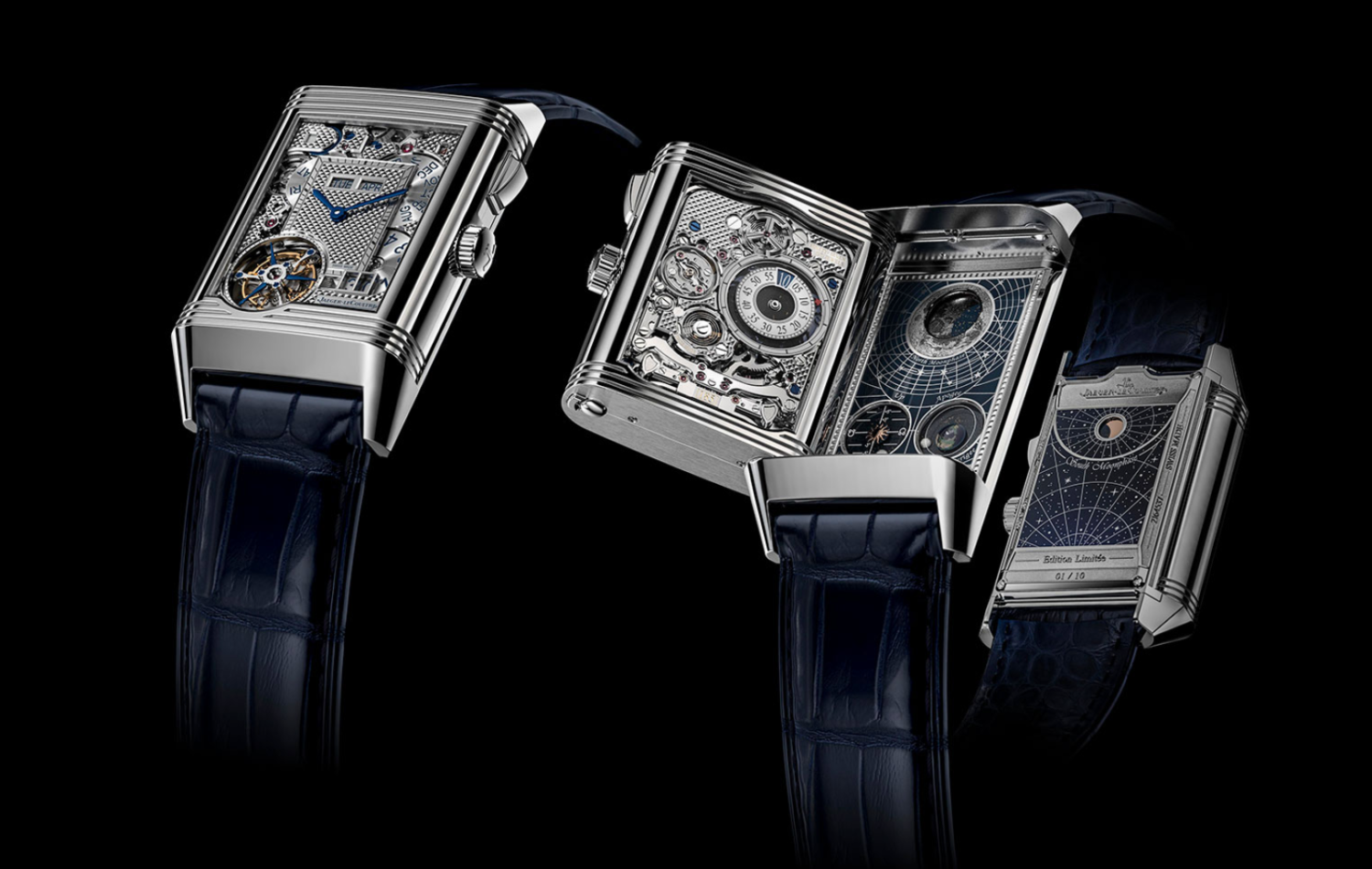
In the world of watches, most designs are aimed at being “seen”: larger dials, brighter night lights, more dazzling diamonds. But there is one watch whose core concept is precisely “to be hidden”. With a gentle push, the watch case flips over, and the fragile glass watch crystal disappears behind the metal back cover. This action has been repeated for over ninety years since 1931. It is called Jaeger-LeCoultre Reverso.
An Invention Born from a Polo Match
The birth of Reverso originated from a business challenge rather than a sudden inspiration from a designer.

In the 1920s, British officers stationed in India were passionate participants in polo. The polo matches were intense, and the watch crystals on their wrists were often shattered by the polo sticks or balls. One officer approached the Swiss businessman César de Trey and proposed: Could you make a watch that could withstand polo impacts? De Trey returned to Europe, found Jaeger-LeCoultre’s Jacques-David Le Coeur, and entrusted French designer René-Alfred Chevalier to design the case.
Chevalier’s solution was extremely ingenious: The case was placed in a flip-up frame. When playing polo, it was flipped over, with the metal backshell facing outward; when looking at the time, it was flipped back, with the dial facing upward. In 1931, Reverso was officially launched and obtained a patent (historical patent number CH159982).
This design not only solved functional problems but also unexpectedly defined aesthetics. The rectangular case, the horizontal decorative engravings on the dial, the triangular case ears – all these elements originated from the then popular Art Deco style. A tool watch designed for the polo field thus became a representative work of decorative art.
The reverse side, originally facing up, became a canvas

At first, the side that was turned over initially was a blank metal back cover. But soon, the wearer began to work on it.
The earliest customization came from Indian princes. The Maharaja of Kapur Talra once ordered 50 Reversos and requested that the back be decorated with an enamel portrait of his wife. This marked another identity for Reverso: a portable custom-made canvas.
Over the following decades, names, family crests, enamel miniatures, and gem inlays appeared on the blank back covers. In 1936, Jaeger-LeCoultre produced a Reverso with an enamel portrait of an Indian princess, called “Indian Beauty,” which remains a treasure in the brand’s museum to this day.
In the 1990s, Jaeger-LeCoultre made a bolder decision: no longer treating the back as just a canvas, but installing a second dial. The 1994 Reverso Duoface had the local time on the front and the second time zone on the back. One watch, two times, two styles. This design later evolved into day and night display, moon phases, and even jump time functions.
From sports watches to devices with complex functions

Reverso was originally a sports watch. But Jaeger-LeCoultre soon realized that the potential of this rectangular case was far beyond that.
After the quartz crisis, in the 1990s, Jaeger-LeCoultre began to infuse Reverso with the blood of high-end watchmaking. In 1991, Reverso Soixantième was launched as a 60th anniversary commemorative model, which was the first Reverso to feature mechanical complications, equipped with power reserve and date display, and the first to use a sapphire crystal back cover.
Over the next decade, Jaeger-LeCoultre challenged technical difficulties almost every year: how to fit complex functions that couldn’t be achieved with round movements into the rectangular case. In 1993, Reverso Tourbillon was introduced, the first rectangular tourbillon. In 1994, Reverso Répétition Minutes, the first rectangular repeater. In 1996, the reverse countdown, 1998, the Geographer, 2000, the perpetual calendar – each model required a redesign of the movement layout to make the complex modules designed for round cases fit into the rectangular space.
In 2021, Reverso Hybris Mechanica Calibre 185 “Quadriptyque” took this path to the extreme. Four-sided dials, 11 complex functions, including perpetual calendar, repeater, tourbillon, and the moon phases for both hemispheres. A total of 10 pieces were made worldwide, with an original price of 1.35 million euros. A watch born for polo, 90 years later has become the highest proof of Jaeger-LeCoultre’s technical prowess.
Why hasn’t it been eliminated?

Reverso has experienced a low point. In the 1960s, the Art Deco style was no longer popular, and production of Reverso was temporarily halted. It wasn’t until 1975 that the market’s interest in Art Deco revived, and Reverso was reintroduced to the product line.
The reason why Reverso survived is completely different from those watch models that relied on marketing to stay alive. The core design of Reverso has remained almost unchanged since 1931: horizontal engravings, triangular case lugs, and the flip mechanism. Jaeger-LeCoultre merely replaced the dials, movements, and decorations within this framework. The size may have changed, and the materials may have been updated, but upon first glance, you can still recognize it as Reverso.
This “visual continuity” is extremely rare in the watch industry. Most brands have to redesign every ten years or they will be considered “outdated”. Reverso doesn’t need to do that. Its design is simple enough and unique enough that time loses its destructive power on it.
In the auction market, Reverso’s performance also confirms this. In 2025, Reverso sold 100 lots more at auctions than in 2024. The most sought-after models are the complex-function versions: chronograph, tourbillon, Gyrotourbillon, with prices continuing to rise. And the early prototypes from the 1930s, because the flip mechanism is not as sturdy as the modern versions, are relatively cheaper and have become the choice for entry-level collectors.
Conclusion
The story of Reverso is a story about “solving problems”.The officer needed a watch that couldn’t be broken. Jaeger-LeCoultre provided him with a watch with a flip-up case. The wearer wanted to engrave something on the back, so Jaeger-LeCoultre gave them a blank canvas. The collector wanted complex functions, so Jaeger-LeCoultre placed a tourbillon and a chronograph inside the rectangular case.
Ninety years have passed, and there are no longer any people playing golf with mechanical watches. But Reverso still exists. Its flipping motion hasn’t changed, the Art Deco lines haven’t changed, and that piece of metal on the back – whether it has a name engraved on it, an enamel painting, or a second dial inside – is still waiting for the next owner to decide what to do with it.
A watch that can be flipped over, when flipped over it is protection, and when flipped back it is time. That middle action is the story of ninety years.
