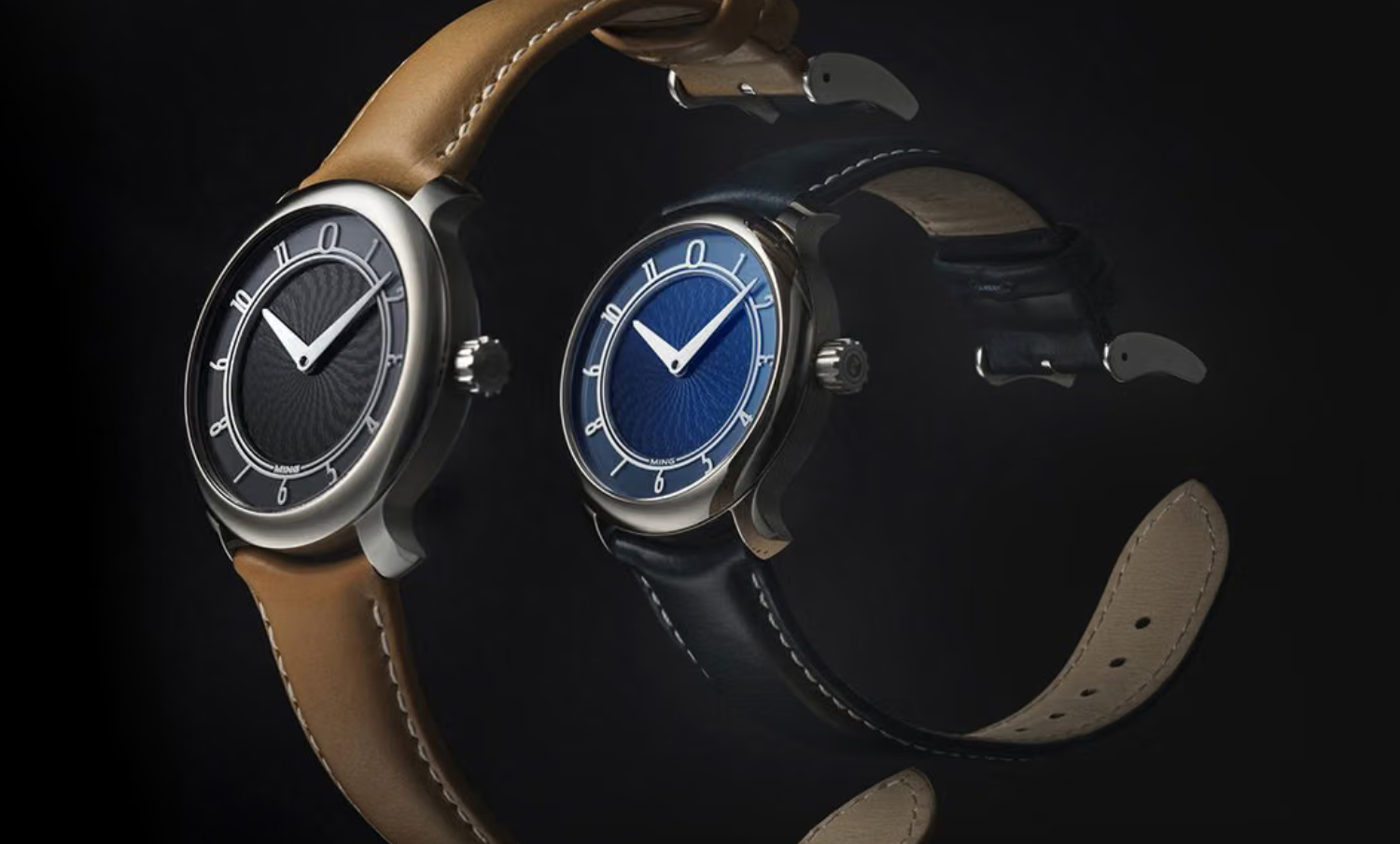
In the world of independent watchmaking, the first pieces of most brands are “practice models”. They are not well-designed, the craftsmanship is not stable, and they manage to survive with the enthusiasm of the founder and the support of a small group of fans. MING is different. When you first look at 17.01, it doesn’t seem like something a new brand could produce. Its proportions, the layers of the dial, and the details are handled with a kind of seasoned restraint, as if the designer has made dozens of watches and is just waiting for the right moment to present it.
The founder, Ming Thein, is not a traditional watchmaker. He is a commercial photographer, graduated from Oxford University with a degree in physics, and has worked in finance and private equity before serving as the chief strategy officer of Hasselblad. He has always had an interest in watches, but it was a very simple idea that truly made him decide to create a brand: to make a good watch that he would be willing to wear every day and at a reasonable price.
A “not like the first watch” first watch

17.01 The most memorable part is that table dial.The center of the dial is a layer of metal disc with enameled texture, surrounded by a ring of blue sapphire crystal. The two layers are stacked together, and when light passes through the sapphire ring, it causes refraction. The dial surface presents completely different levels of depth at different angles. The hour markers are printed on the sapphire ring, and the white Arabic numerals are restrained in style. The 12 o’clock position uses “0” instead of “12”, which is the visual language established by MING from the very first watch. The hands and hour markers are coated with luminous material, and the “MING” at the 6 o’clock position subtly indicates the brand identity.
The case is made of 5-grade titanium metal, with a diameter of 38 millimeters and a thickness of 9.3 millimeters. This size is relatively small nowadays, but the lightness of titanium makes it almost invisible on the wrist. The lugs are short and flared, the crown is large, and it is engraved with an “M” mark. It is much easier to operate than many small crowns. The sapphire crystal is slightly arched, giving it a touch of retro charm, but the overall style is clean and modern.
The movement is the Sellita SW210-1 manual winding, with a power reserve of 42 hours, and a concealed bottom design. From today’s standards, this movement has nothing to boast about. However, MING’s choice is very honest: at this price point, rather than fitting an unknown “in-house movement”, it is better to use a reliable movement that anyone can repair and whose parts are readily available. The budget should be spent on tangible things – the case, the dial, and the polishing.
It can be sold out, and it’s being sold very quickly

17.01 comes in a limited quantity of 150 pieces for each color, 150 pieces each for blue and coal-gray, totaling 300 pieces. It was officially released in August 2017 and priced at $900. By October of the same year, all were sold out.
In a later review, MING wrote a passage that vividly captured the mindset of the brand at that time: “We received many emails saying that the 17.01 could be priced higher, or that some people were willing to pay more to get in line ahead of others. But that would go against our original intention: to offer a mature piece at an accessible price.” They even explicitly stated that they would continue to “price lower relative to the value” in the future, because they hoped that buyers would be pleasantly surprised and then come back to buy a second piece.
This attitude is not common among micro brands. Most independent brands’ first watch is priced based on the logic of “just break even”. MING, from the very beginning, was making a longer-term decision: to build trust with the first watch rather than extracting the first wave of profits.
Why did it become so popular?

The reason for the success of the 17.01 model is different from that of its later more expensive and complex models.
It did not use any “exclusive technology”. Titanium casing, sapphire dial, Sellita movement – these elements could be found in the micro-brand market in 2017. Its advantage lies in the aesthetic judgment ability to combine these elements together. Ming Thein’s background as a photographer came into play here: he knew what looked good in the camera and what looked good on the wrist. These two things are not always the same, but the 17.01 managed to do both at the same time.
Another reason was honesty. The price of $900 was set without attempting to pretend it was a “budget Patek Philippe” or using marketing rhetoric to package the Sellita movement as a “self-developed”. MING clearly stated in their official blog: We made a watch that we would be willing to wear, priced within an affordable range, and once sold out, it was sold out. This honesty is extremely rare in the watch industry and almost a luxury.
Of course, the limited production of 150 pieces also helped. The total production of 300 pieces was sold out within two months after the release, and most buyers had not even seen the physical product before receiving the watch. This “blind purchase” courage comes from trust in the founder’s taste and also from a common optimistic mood in the micro-brand circle during that period.
Final Thoughts
The MING 17.01 is not a perfect watch. The deep case design makes the movement completely unattractive, and the Sellita movement’s finish lacks any sense of “high-end”. The 38mm size might be too small for those who are used to larger watches. However, it is a type of watch that you will forget it exists once you put it on, and when you look at the time, you will feel a good mood.
In today’s era where micro brands are getting increasingly competitive, looking back at the 17.01, it is more like a starting point rather than a peak. Later on, MING produced more complex 19 series, received nominations for GPHG, and launched models with its own movement. But the set of logic established by the 17.01 – prioritizing aesthetics, keeping the pricing in an honest position, and limiting the production to just enough to sell out – remains the core of this brand to this day.
A watch priced at $900, and several years later, people are still searching the world for it. This event itself is the best evaluation for a micro brand.
