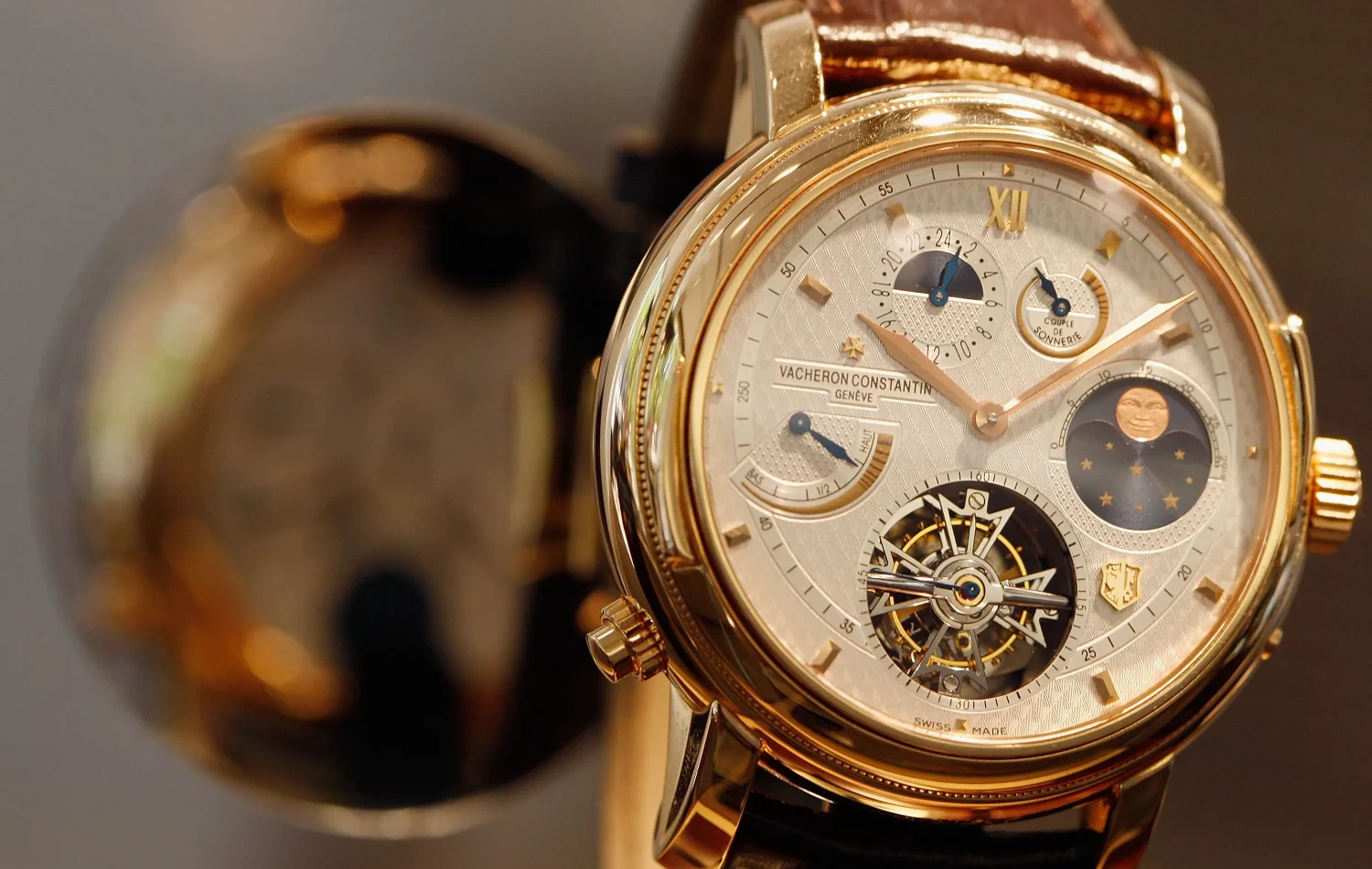
Few watch brands can perfectly embody the tradition and heritage of Swiss watchmaking like Vacheron Constantin. Founded in 1755, 21 years earlier than the founding of the United States, it is the oldest continuously operating watchmaking brand in the world. It has weathered the French Revolution, the Napoleonic Wars, the two World Wars and the quartz crisis, yet has never ceased production for a single day.Starting from a small watchmaking workshop in Geneva, relying on the exquisite craftsmanship passed down from generation to generation and adhering to the essence of high-end watchmaking, it has now been highly respected by the world as the “father of watchmaking”.
This article will trace the origin and development history of Vacheron Constantin, discuss its influence spanning across centuries, and explain why it has always been the benchmark in the hearts of collectors and watch enthusiasts.
Origin: An apprenticeship contract is equivalent to a birth certificate.

The story of Vacheron Constantin began in Geneva in 1755. At that time, the 24-year-old young watchmaker Jean-Marc Vacheron did something that was not uncommon at that time: he recruited an apprentice and signed a contract.
The contract itself was nothing special – in that era, it was common for artisans to take in apprentices. But the signature on this contract made it one of the most important documents in the history of watchmaking two hundred years later. The young man whose signature was on it was called Jean-Marc Vacheron, and the apprenticeship contract he signed was regarded by Vacheron Constantin as the brand’s “birth certificate”.
Why could an apprenticeship contract become a “birth certificate”? Because what was written in the contract was not just “teaching the craft”, but a commitment to “passing on the skills”. At the moment Jean-Marc took in the apprentice, he had already decided to continue this craft rather than stop after making a few years of money. It was this “inheritance” gene that gave Vacheron Constantin an identity that no other brand could match: the world’s longest-running watchmaking brand.
The encounter of these two names has given birth to the soul of the brand.

When the brand was first established, it was called “Vacheron”, but the current name “Vacheron Constantin” originated from a crucial collaboration in 1819.
That year, the founder’s grandson, Jacques-Bartremy Vacheron, met the merchant François Constantin. One was a technical expert from a watchmaking family, and the other was a business-minded person who had traveled far and wide – the two hit it off immediately, and the brand was renamed Vacheron Constantin.
Constantin traveled throughout Europe for thirty years to expand the brand’s market. On July 5, 1819, he wrote a letter to his partner in Turin, Italy. In the letter, there was a sentence that later became the motto of Vacheron Constantin: “Do your best if possible, and it is always possible.”
This sentence is not a marketing slogan. It was written in the letter and was Constantin’s commitment to Vacheron: Commercial success cannot be achieved at the expense of craftsmanship.
The Maltese Cross: From a “Component” to a “Symbol”

In 1880, Vacheron Constantin needed a brand logo. Instead of asking a designer to create an abstract graphic, they took a component from their own movement.
This component was called the Maltese Cross. It was originally a precise part on the tension box cover, whose function was to maintain the torque stability of the spring when it released energy, thereby making the timekeeping more accurate.
Vacheron Constantin transformed this component into the brand logo. This choice itself says it all: the “face” of the brand is not an external decoration, but the internal movement. A mechanical part used to ensure accuracy has become the symbol of the brand. This is the most honest “brand design” in the watchmaking industry.
The “ancestor” of technology: The founder of standardized production

If “continuous operation” earned Vacheron Constantin the title of “pioneer”, then its technological contributions gave this title a substantive meaning.
In 1839, Vacheron Constantin hired the mechanical engineering genius Georges-Auguste Lescure. The “watchmaking proportion drawing machine” he improved enabled the standardized manufacturing of watch components, allowing for proportional scaling and interchangeability. Before this, each watch movement’s components were individually handcrafted, and when broken, they could only be remade. After standardization, the components could be mass-produced, ensuring consistent quality, and when broken, they could be directly replaced.
In 1844, the Geneva Art Association awarded the “Rive Prize” to this invention, recognizing it as “the most valuable invention in Geneva’s industry”. Vacheron Constantin’s standardized production paved the way for the entire Swiss watchmaking industry to transition from artisan workshops to industrialization.
The Master Craftsmen of the Attic: Living Heritage of the Watchmaking Industry
Vacheron Constantin has another tradition that cannot be found elsewhere: the “Les Cabinotiers” .
In 18th-century Geneva, the workshops of watchmaking masters were usually located on the top floor of buildings, working with natural light, and thus “Cabinotiers” was derived from this. Today, Vacheron Constantin uses this name to name its bespoke department, specializing in the creation of unique timepieces, integrating handcrafts such as engraving, enamelwork, and mechanical engraving.
In 2015, Vacheron Constantin launched reference number 57260, featuring 57 complex functions, completed by three watchmaking masters over eight years, and hailed as “the most intricate and complex watch in the history of watchmaking“. The existence of this department makes “pioneer” not just a historical title, but a living and ongoing heritage.
Modern Chapter: Harmony of Tradition and Innovation

Entering the 21st century, Vacheron Constantin has maintained its traditional style while continuously advancing technological innovation.
From the minimalist elegance of the Patrimony series, to the sporty style of the Overseas series, and to the classic complex functions of the Traditionnelle series, Vacheron Constantin’s product line covers all levels from beginner to top-level. But in every series, one can see the brand’s commitment to the word “inheritance“: the movement must be finely polished, the case must conform to strict proportions, and every part must withstand the scrutiny of a magnifying glass.
In 2019, Vacheron Constantin launched complex-function wristwatches with dual chronograph hands, perpetual calendar, and tourbillon, while also constantly breaking new ground in materials and craftsmanship. However, the brand’s core has never changed – it has always been a watchmaking factory with “inheritance” as its belief.
Pop culture and the world of collecting: Vacheron Constantin

Although some luxury wristwatches are renowned for their complex functions, the charm of Vacheron Constantin lies in its cultural symbolic significance. It represents an eternal taste – a taste that does not chase after trends but leads them.
Collectors often compare Vacheron Constantin to the “consensus” among advanced watchmakers. It is not a wristwatch that flaunts wealth, but a symbol of refined discernment.
In the auction market, vintage Vacheron Constantin has always been a sought-after object by collectors. A 1950s Vacheron Constantin chronograph wristwatch, or a piece by a loft artisan with a beautifully decorated enamel dial, often fetches prices far exceeding the estimate. Its design has now become a synonym for high-end watchmaking, and even from a distance, it can be easily recognized.
Conclusion: The answer of the originator of table-making
Vacheron Constantin is not merely a wristwatch; it is a design manifesto that transcends time, fashion and generations. It originated from an apprenticeship contract in 1755 and has undergone decades of technological innovation. It is deeply loved by discerning collectors. Today, it has become a symbol of pure heritage.
In this era of wristwatches where large diameters and complex functions are the trend, Vacheron Constantin is telling us: Truly high-end design lies in its ability to transcend time. The smooth and elegant shell lines, the precise and reliable movement, combined with the uninterrupted century-long history, precisely echo the brand’s motto: Do your best if possible, and it is always possible.
Whether you are a seasoned collector of wristwatches or a newcomer who has just discovered Vacheron Constantin, it is more than just a wristwatch. It is a piece of heritage that can be passed down from generation to generation and is worthy of being cherished with care.
