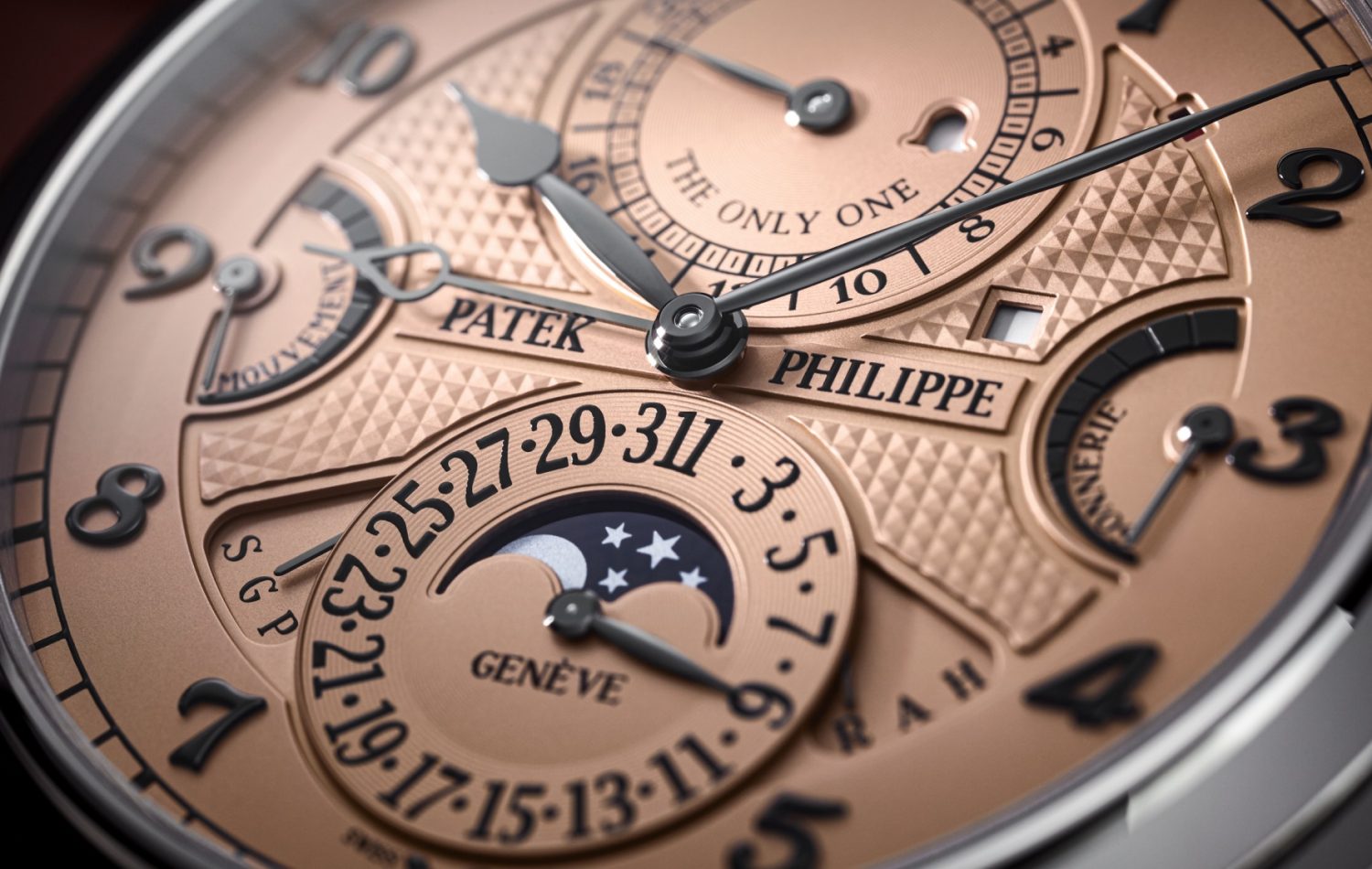
In the world of watch collecting, certain colors make bold statements—bright green, icy blue, rainbow gradients—seen first on social media and forgotten just as quickly. Salmon pink is different. It doesn’t shout; it whispers. Those who understand recognize it at once, while others dismiss it as just an old watch.
Sotheby’s watch expert Leigh Zagoory put it perfectly: “Salmon-colored dials always command incredible prices,” and “they’re rare, yet still very neutral.” This captures the core appeal for collectors: rare, yet universally wearable. You don’t need to dress a certain way or wear it for a specific occasion—a salmon dial works in any context. Unlike gold cases that draw attention or black dials that feel dull, it’s a rare gem in watch collecting: quietly special.
From “Customized for You” to “Collectors’ Codes”

The salmon-colored collection gene has always carried the mark of “the few”. This color first appeared in the 1930s and 1940s, usually in a small number of custom-made pieces for distinguished clients. It was not a mass production option but something that “you have to know the right person to get”.
This “customization gene” has continued to this day. In 2021, a 1948 Patek Philippe 1518 with a salmon-colored dial was sold for $9.6 million at Sotheby’s, becoming the most expensive wristwatch in the auction house’s history that year. 1518 itself is a legend – it is Patek Philippe’s first perpetual calendar chronograph. And the salmon-colored version is known to exist in only 13 pieces. To such an extent of rarity, whether you can encounter it is no longer a matter of “whether it’s high or not”, but rather a matter of “whether you can find it”.
Patek Philippe has always been extremely restrained in its use of salmon color, and it is almost exclusively found on the most complex models: the perpetual calendar chronograph 5270, the double chronograph 5372, the perpetual calendar 5320, and the world time chronograph 5935. Its strategy is clear: salmon color is not an embellishment for entry-level models, but rather a “identity card” for the top-level complex functions. When collectors see a Patek Philippe with a salmon-colored plate, they immediately know that this watch is not ordinary.
“Transparency in Materials and Craftsmanship”

Lange’s approach has pushed the “materiality” of salmon-colored material to the extreme. The Datograph Perpetual Tourbillon launched in 2019 has a solid rose gold dial, with a matte grain finish on the surface and no coating. The warm pink hue you see is the actual color of the metal itself.
This “honesty” has a fatal appeal to collectors. Paint can be adjusted, electroplating can imitate, but the color of a solid rose gold dial is the result of the combined effect of the material and craftsmanship, and cannot be replicated. This is one of the reasons why salmon color is called a “treasure dial” in the collecting circle – the difficulty of its production itself is in selecting the brand: color adjustment and electroplating have low finished rates, and the output is inevitably limited.
At the SIHH that year, the salmon color of this watch triggered polar reactions: some questioned why Lange chose such an “unusual color”, while others thought that this hue gave the watch a unique warm texture. But regardless of the evaluation, Lange’s approach is indisputably “Lange” – it turned a color into a material issue. While others were thinking “what kind of paint to use to achieve this color”, Lange directly cut a piece of rose gold.
A detail that makes the collector’s heart race

If you zoom in and examine the salmon-colored dial of the Patek Philippe 5270P, you will notice an overlooked fact: The official name for this color is “rose-gilt opaline“, which is achieved by electroplating 3N gold onto the brass dial.
3N gold is a specific gold-copper alloy formula that lies between 2N rose gold and 4N powder gold. Patek Philippe has been using this method since at least the 1940s, and the 5270P is the first regular production 5270 series platinum dial salmon-colored model. Before this, salmon dials were almost exclusively found in special custom or limited editions in Patek Philippe’s product line. This “transition from exception to norm, yet still rare” precisely explains why collectors are also flocking to modern salmon dials. After the 5270P stopped production in 2022, its attention in the second-hand market has increased rather than decreased. A collector recorded on a forum that they only truly realized the significance of this watch after the production halt was announced in February 2022.
A rediscovered timekeeping tradition

The salmon color of the Montblanc Heritage Pulsograph carries with it a forgotten history of timekeeping. Its inspiration comes from the “doctor’s watches” manufactured by Minerva from the 1940s to the 1950s – in a time without electronic blood pressure monitors, doctors used chronographs in combination with the pulse count markings on the outer dial to count the number of heartbeats until they stopped, directly reading the heart rate. After Montblanc acquired Minerva in 2006, they unearthed this tradition from their archives.
The salmon color of this watch is not for “looks”. The curved dial outer ring is engraved with blue pulse count markings, and the central chronograph seconds hand is also blue – the contrast between the cool color and the warm-colored base makes the readings clear at a glance. The MB M13.21 mechanical movement it is equipped with is derived from Minerva’s 13.20 chronograph movement from the 1920s, featuring a column wheel, horizontal clutch, and a traditional frequency of 2.5 Hz, each of which is a standard feature of “antique chronographs”. It is limited to 100 pieces, with a stainless steel case, and priced much lower than Patek Philippe and Lange. Its salmon color is an entry-level historical document – you don’t need to be a major collector at an auction to own a “storytelling watch”.
The last thing I want to say
Collectors prefer the salmon color because, ultimately, it satisfies two seemingly contradictory demands: you want something rare, and it delivers; but you don’t want to be noticed, and it doesn’t make you feel embarrassed either.
A black-dial gold watch will be seen on the dining table, and a green-dial steel watch will be recognized in a coffee shop. A Patek Philippe 5270 with a salmon-colored face, for those who understand, will cause a stir in their hearts; for those who don’t, they will merely think the color of the dial is quite nice. This “sending signals only to a specific group of people” trait is what the collecting circle is most obsessed with.
And the existence of the Montblanc Heritage Pulsograph precisely proves that salmon color is not just the game of a small group of top collectors – it can belong to the platinum perpetual calendar of Patek Philippe, to the solid rose gold of Lange, or to a steel doctor’s watch. The same color, in different cases, carries completely different histories and weights.
